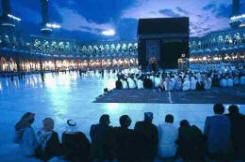
Pilgrimmage (Hajj)
Volume 2, Book 26,
Number 589:
Narrated 'Abdullah bin Abbas :
Al-Fadl (his brother) was riding behind
Allah's Apostle and a woman from the tribe of Khath'am came and Al-Fadl
started looking at her and she started looking at him. The Prophet
turned Al-Fadl's face to the other side. The woman said, "O Allah's
Apostle! The obligation of Hajj enjoined by Allah on His devotees
has become due on my father and he is old and weak, and he cannot
sit firm on the Mount; may I perform Hajj on his behalf?" The
Prophet replied, "Yes, you may." That happened during the Hajj-al-Wida
(of the Prophet ).
Volume 2, Book 26,
Number 590:
Narrated Ibn 'Umar:
I saw that Allah's Apostle used to ride on
his Mount at Dhul Hulaifa and used to start saying, "Labbaik" when
the Mount stood upright.
Volume 2, Book 26,
Number 591:
Narrated Jabir bin 'Abdullah :
that Allah's Apostle started saying,
"Labbaik" from Dhul-Hulaifa when his Mount stood upright carrying
him .
Volume 2, Book 26,
Number 592:
Narrated Thumama bin 'Abdullah bin Anas:
Anas performed the Hajj on a pack-saddle
and he was not a miser. Anas said, "Allah's Apostle
performed Hajj on a pack-saddle and the
same Mount was carrying his baggage too."
Volume 2, Book 26,
Number 593:
Narrated Al-Qasim bin Muhammad:
'Aisha said, "O Allah's Apostle! You
performed 'Umra but I did not." He said, "O 'Abdur-Rahman! Go along
with your sister and let her perform 'Umra from Tan'im."
'Abdur-Rahman made her ride over the pack-saddle of a she-camel and
she performed 'Umra.
Volume 2, Book 26,
Number 594:
Narrated Abu Huraira:
The Prophet was asked, "Which is the best
deed?" He said, "To believe in Allah and His Apostle." He was then
asked, "Which is the next (in goodness)?" He said, "To participate
in Jihad in Allah's Cause." He was then asked, "Which is the next?"
He said, "To perform Hajj-Mabrur. "
Volume 2, Book 26,
Number 595:
Narrated 'Aisha:
(the mother of the faithful believers) I
said, "O Allah's Apostle! We consider Jihad as the best deed." The
Prophet said, "The best Jihad (for women) is Hajj Mabrur. "
Volume 2, Book 26,
Number 596:
Narrated Abu Huraira:
The Prophet (p.b.u.h) said, "Whoever
performs Hajj for Allah's pleasure and does not have sexual
relations with his wife, and does not do evil or sins then he will
return (after Hajj free from all sins) as if he were born anew."
Volume 2, Book 26,
Number 597:
Narrated Zaid bin Jubair:
I went to visit 'Abdullah bin 'Umar at his
house which contained many tents made of cotton cloth and these were
encircled with Suradik (part of the tent). I asked him from where,
should one assume Ihram for Umra. He said, "Allah's Apostle had
fixed as Miqat (singular of Mawaqit) Qarn for the people of Najd,
Dhul-Hulaifa for the people of Medina, and Al-Juhfa for the people
of Sham."
Volume 2, Book 26,
Number 598:
Narrated Ibn Abbas:
The people of Yemen used to come for Hajj
and used not to bring enough provisions with them and used to say
that they depend on Allah. On their arrival in Medina they used to
beg the people, and so Allah revealed, "And take a provision (with
you) for the journey, but the best provision is the fear of Allah."
(2.197).
Volume 2, Book 26,
Number 599:
Narrated Ibn Abbas:
Allah's Apostle (p.b.u.h) made Dhul-Huiaifa
as the Miqat for the people of Medina; Al-Juhfa for the people of
Sham; Qarn-al-Manazil for the people of Najd; and Yalamlam for the
people of Yemen; and these Mawaqit are for the people at those very
places, and besides them for those who come thorough those places
with the intention of performing Hajj and 'Umra; and whoever is
living within these boundaries can assume lhram from the place he
starts, and the people of Mecca can assume Ihram from Mecca.
Volume 2, Book 26,
Number 600:
Narrated Nafi':
'Abdullah bin 'Umar said, "Allah's Apostle
said, 'The people of Medina should assume lhram from Dhul-Hulaifa;
the people of Sham from Al-Juhfa; and the people of Najd from Qarn."
And 'Abdullah added, "I was informed that Allah's Apostle had said,
'The people of Yemen should assume Ihram from Yalamlam.' "
Volume 2, Book 26,
Number 601:
Narrated Ibn Abbas :
Allah's Apostle had fixed Dhul Hulaifa as
the Mlqat for the people of Medina; Al-Juhfa for the people of Sham;
and Qarn Ul-Manazil for the people of Najd; and Yalamlam for the
people of Yemen. So, these (above mentioned) are the Mawaqit for all
those living at those places, and besides them for those who come
through those places with the intention of performing Hajj and 'Umra
and whoever lives within these places should assume Ihram from his
dwelling place, and similarly the people of Mecca can assume lhram
from Mecca.
Volume 2, Book 26,
Number 602:
Narrated Salim from his father who said,:
"The Prophet had fixed the Mawaqit as
follows: (No. 603)
Volume 2, Book 26,
Number 603:
Narrated Salim bin 'Abdullah from his
father:
I heard Allah's Apostle saying, "The Miqat
for the people of Medina is Dhul-Hulaifa; for the people of Sham is
Mahita; (i.e. Al-Juhfa); and for the people of Najd is Qarn. And
said Ibn 'Umar, "They claim, but I did not hear personally, that the
Prophet said, "The Miqat for the people of Yemen is Yalamlam."
Volume 2, Book 26,
Number 604:
Narrated Ibn Abbas:
The Prophet fixed Dhul-Hulaifa as the Miqat
for the people of Medina, Al-Juhfa, for the people of Sham, Yalamlam
for the people of Yemen, and Qarn for the people of Najd. And these
Mawaqlt are for those living at those very places, and besides them
for those who come through those places with the intention of
performing Hajj and Umra; and whoever is living inside these places
can assume lhram from his own dwelling place, and the people of
Mecca can assume lhram from Mecca.
Volume 2, Book 26,
Number 605:
Narrated Ibn Abbas:
The Prophet (p.b.u.h) fixed Dhul-Hulaifa as
the Miqat for the people of Medina, Al-Juhfa for the people of Sham,
Qarn-ul-Manazil for the people of Najd, and Yalamlam for the people
of Yemen; and these Mawaqit are for those living at those very
places, and besides them for those whom come through them with the
intention of performing Hajj and Umra; and whoever is living within
these Mawaqit should assume lhram from where he starts, and the
people of Mecca can assume Ihram from Mecca.
Volume 2, Book 26,
Number 606:
Narrated Ibn Umar:
When these two towns (Basra and Kufa) were
captured, the people went to 'Umar and said, "O the Chief of the
faithful believers! The Prophet fixed Qarn as the Miqat for the
people of Najd, it is beyond our way and it is difficult for us to
pass through it." He said, "Take as your Miqat a place situated
opposite to Qarn on your usual way. So, he fixed Dhatu-Irq (as their
Miqat)."
Volume 2, Book 26,
Number 607:
Narrated Nafi :
'Abdullah bin 'Umar' said, "Allah's Apostle
made his camel sit (i.e. he dismounted) at Al-Batha' in Dhul-Hulaifa
and offered the prayer." 'Abdullah bin 'Umar used to do the same.
Volume 2, Book 26,
Number 608:
Narrated Ibn 'Umar :
Allah's Apostle used to go (for Hajj) via
Ash-Shajara way and return via Muarras way; and no doubt, whenever
Allah's Apostle went to Mecca, he used to offer the prayer in the
Mosque of Ash-Shajara; and on his return, he used to offer the
prayer at Dhul-Hulaifa in the middle of the valley, and pass the
night there till morning.
Volume 2, Book 26,
Number 609:
Narrated 'Umar:
In the valley of Al-'Aqiq I heard Allah's
Apostle saying, "To night a messenger came to me from my Lord and
asked me to pray in this blessed valley and to assume Ihram for Hajj
and 'Umra together. "
Volume 2, Book 26,
Number 610:
Narrated Musa bin 'Uqba:
Salim bin 'Abdullah's father said, "The
Prophet said that while resting in the bottom of the valley at
Mu'arras in Dhul-Hulaifa, he had been addressed in a dream: 'You are
verily in a blessed valley.' " Salim made us to dismount from our
camels at the place where 'Abdullah used to dismount, aiming at the
place where Allah's Apostle had rested and it was below the Mosque
situated in the middle of the valley in between them (the residence)
and the road.
Volume 2, Book 26,
Number 611:
Narrated Said bin Jubair:
Ibn 'Umar used to oil his hair. I told that
to Ibrahim who said, "What do you think about this statement:
Narrated Aswad from 'Aisha: As if I were now observing the glitter
of the scent in the parting of the hair of the Prophet while he was
Muhrim?"
Volume 2, Book 26,
Number 612:
Narrated 'Aisha:
(the wife of the Prophet (p.b.u.h) I used
to scent Allah's Apostle when he wanted to assume Ihram and also on
finishing Ihram before the Tawaf round the Ka'ba (Tawaf-al-ifada).
Volume 2, Book 26,
Number 613:
Narrated Salim from his father:
I heard that Allah's Apostle assumed Ihram
with his hair matted together.
Volume 2, Book 26,
Number 614:
Narrated Salim bin 'Abdullah :
I heard my father saying, "Never did
Allah's Apostle assume Ihram except at the Mosque, that is, at the
Mosque of Dhul-Hulaifa.
Volume 2, Book 26,
Number 615:
Narrated 'Abdullah bin 'Umar:
A man asked, "O Allah's Apostle! What kind
of clothes should a Muhrim wear?" Allah's Apostle replied, "He
should not wear a shirt, a turban, trousers, a headcloak or leather
socks except if he can find no slippers, he then may wear leather
socks after cutting off what might cover the ankles. And he should
not wear clothes which are scented with saffron or Wars (kinds of
Perfumes) . "
Volume 2, Book 26,
Number 616:
Narrated 'Ubaidullah bin 'Abdullah:
Ibn Abbas' said, "Usama rode behind Allah's
Apostle from 'Arafat to Al-Muzdalifa; and then Al-Fadl rode behind
Allah's Apostle from Al-Muzdalifa to Mina." Ibn Abbas added, "Both
of them said, 'The Prophet kept on reciting Talbiya till he did the
Rami of Jamrat-al-'Aqaba.' "
Volume 2, Book 26,
Number 617:
Narrated 'Abdullah bin Abbas:
The Prophet with his companions started
from Medina after combing and oiling his hair and putting on two
sheets of lhram (upper body cover and waist cover). He did not
forbid anyone to wear any kind of sheets except the ones colored
with saffron because they may leave the scent on the skin. And so in
the early morning, the Prophet mounted his Mount while in
Dhul-Hulaifa and set out till they reached Baida', where he and his
companions recited Talbiya, and then they did the ceremony of Taqlid
(which means to put the colored garlands around the necks of the
Budn (camels for sacrifice). And all that happened on the 25th of
Dhul-Qa'da. And when he reached Mecca on the 4th of Dhul-Hijja he
performed the Tawaf round the Ka'ba and performed the Tawaf between
Safa and Marwa. And as he had a Badana and had garlanded it, he did
not finish his Ihram. He proceeded towards the highest places of
Mecca near Al-Hujun and he was assuming the Ihram for Hajj and did
not go near the Ka'ba after he performed Tawaf (round it) till he
returned from 'Arafat. Then he ordered his companions to perform the
Tawaf round the Ka'ba and then the Tawaf of Safa and Marwa, and to
cut short the hair of their heads and to finish their Ihram. And
that was only for those people who had not garlanded Budn. Those who
had their wives with them were permitted to contact them (have
sexual intercourse), and similarly perfume and (ordinary) clothes
were permissible for them.
Volume 2, Book 26,
Number 618:
Narrated Anas bin Malik:
The Prophet offered four Rakat in Medina
and then two Rakat at DhulI lulaifa and then passed the night at
Dhul-Hulaifa till it was morning and when he mounted his Mount and
it stood up, he started to recite Talbiya.
Volume 2, Book 26,
Number 619:
Narrated Abu Qilaba:
Anas bin Malik said, "The Prophet offered
four Rakat of the Zuhr prayer in Medina and two Rakat of 'Asr prayer
at Dhul-Hulaifa." I think that the Prophet passed the night there
till morning.
Volume 2, Book 26,
Number 620:
Narrated Anas:
The Prophet offered four Rakat of the Zuhr
prayer in Medina and two Rakat of the 'Asr prayer in Dhul-Hulaifa
and I heard them (the companions of the Prophet) reciting Talbiya
together loudly to the extent of shouting.
Volume 2, Book 26,
Number 621:
Narrated 'Abdullah bin 'Umar :
The Talbiya of Allah's Apostle was :
'Labbaika Allahumma labbaik, Labbaika la sharika Laka labbaik,
Inna-l-hamda wan-ni'mata Laka walmu Lk, La sharika Laka' (I respond
to Your call O Allah, I respond to Your call, and I am obedient to
Your orders, You have no partner, I respond to Your call All the
praises and blessings are for You, All the sovereignty is for You,
And You have no partners with you.
Volume 2, Book 26,
Number 622:
Narrated 'Aisha:
I know how the Prophet used to say
(Talbiya) and it was: 'Labbaika Allahumma Labbaik, Labbaika la
sharika Laka labbaik, Inna-l-hamda wan-ni'mata Laka walmu Lk, La
sharika Laka'.
Volume 2, Book 26,
Number 623:
Narrated Anas bin Malik:
Allah's Apostle offered four Rakat of Zuhr
prayer at Medina and we were in his company, and two Rakat of the
Asr prayer at Dhul-Hulaifa and then passed the night there till it
was dawn; then he rode, and when he reached Al-Baida', he praised
and glorified Allah and said Takbir (i.e. Alhamdu-lillah and
Subhanallah(1) and Allahu-Akbar). Then he and the people along with
him recited Talbiya with the intention of performing Hajj and Umra.
When we reached (Mecca) he ordered us to finish the lhram (after
performing the Umra) (only those who had no Hadi (animal for
sacrifice) with them were asked to do so) till the day of Tarwiya
that is 8th Dhul-Hijja when they assumed Ihram for Hajj. The Prophet
sacrificed many camels (slaughtering them) with his own hands while
standing. While Allah's Apostle was in Medina he sacrificed two
horned rams black and white in color in the Name of Allah."
Volume 2, Book 26,
Number 624:
Narrated Ibn Umar:
The Prophet (p.b.u.h) recited Talbiya when
he had mounted his Mount and was ready to set out.
Volume 2, Book 26,
Number 625:
Narrated Nafi':
Whenever Ibn 'Umar intended to go to Mecca
he used to oil himself with a sort of oil that had no pleasant
smell, then he would go to the Mosque of Al-Hulaita and offer the
prayer, and then ride. When he mounted well on his Mount and the
Mount stood up straight, he would proclaim the intention of assuming
Ihram, and he used to say that he had seen the Prophet doing the
same.
Volume 2, Book 26,
Number 626:
Narrated Mujahid:
I was in the company of Ibn Abbas and the
people talked about Ad-Dajjal and said, "Ad-Dajjal will come with
the word Kafir (non-believer) written in between his eyes." On that
Ibn Abbas said, "I have not heard this from the Prophet but I heard
him saying, 'As if I saw Moses just now entering the valley reciting
Talbyia. ' "
Volume 2, Book 26,
Number 627:
Narrated Aisha:
(the wife of the Prophet (p.b.u.h) We set
out with the Prophet in his last Hajj and we assumed Ihram for Umra.
The Prophet then said, "Whoever has the Hadi with him should assume
Ihram for Hajj along with 'Umra and should not finish the Ihram till
he finishes both." I was menstruating when I reached Mecca, and so I
neither did Tawaf round the Ka'ba nor Tawaf between Safa and Marwa.
I complained about that to the Prophet on which he replied, "Undo
and comb your head hair, and assume Ihram for Hajj (only) and leave
the Umra." So, I did so. When we had performed the Hajj, the Prophet
sent me with my brother 'Abdur-Rahman bin Abu Bakr to Tan'im. So I
performed the 'Umra. The Prophet said to me, "This 'Umra is instead
of your missed one." Those who had assumed Ihram for 'Umra
(Hajj-atTamattu) performed Tawaf round the Ka'ba and between Safa
and Marwa and then finished their Ihram. After returning from Mina,
they performed another Tawaf (between Safa and Marwa). Those who had
assumed Ihram for Hajj and 'Umra together (Hajj-al-Qiran) performed
only one Tawaf (between Safa and Marwa).
Volume 2, Book 26,
Number 628:
Narrated Ata:
Jabir said, "The Prophet ordered Ali to
keep on assuming his Ihram." The narrator then informed about the
narration of Suraqa.
Volume 2, Book 26,
Number 629:
Narrated Anas bin Malik:
Ali came to the Prophet (p.b.u.h) from
Yemen (to Mecca). The Prophet asked Ali, "With what intention have
you assumed Ihram?" Ali replied, "I have assumed Ihram with the same
intention as that of the Prophet." The Prophet said, "If I had not
the Hadi with me I would have finished the Ihram." Muhammad bin Bakr
narrated extra from Ibn Juraij, "The Prophet said to Ali, "With what
intention have you assumed the Ihram, O Ali?" He replied, "With the
same (intention) as that of the Prophet." The Prophet said, "Have a
Hadi and keep your Ihram as it is."
Volume 2, Book 26,
Number 630:
Narrated Abu Musa:
The Prophet sent me to some people in Yemen
and when I returned, I found him at Al-Batha. He asked me, "With
what intention have you assumed Ihram (i.e. for Hajj or for Umra or
for both?") I replied, "I have assumed Ihram with an intention like
that of the Prophet." He asked, "Have you a Hadi with you?" I
replied in the negative. He ordered me to perform Tawaf round the
Ka'ba and between Safa and Marwa and then to finish my Ihram. I did
so and went to a woman from my tribe who combed my hair or washed my
head. Then, when Umar came (i.e. became Caliph) he said, "If we
follow Allah's Book, it orders us to complete Hajj and Umra; as
Allah says: "Perform the Hajj and Umra for Allah." (2.196). And if
we follow the tradition of the Prophet who did not finish his Ihram
till he sacrificed his Hadi."
Volume 2, Book 26,
Number 631:
Narrated Al-Qasim bin Muhammad:
' Aisha said, "We set out with Allah's
Apostles in the months of Hajj, and (in) the nights of Hajj, and at
the time and places of Hajj and in a state of Hajj. We dismounted at
Sarif (a village six miles from Mecca). The Prophet then addressed
his companions and said, "Anyone who has not got the Hadi and likes
to do Umra instead of Hajj may do so (i.e. Hajj-al-Tamattu) and
anyone who has got the Hadi should not finish the Ihram after
performing ' Umra). (i.e. Hajj-al-Qiran). Aisha added, "The
companions of the Prophet obeyed the above (order) and some of them
(i.e. who did not have Hadi) finished their Ihram after Umra."
Allah's Apostle and some of his companions were resourceful and had
the Hadi with them, they could not perform Umra (alone) (but had to
perform both Hajj and Umra with one Ihram). Aisha added, "Allah's
Apostle came to me and saw me weeping and said, "What makes you
weep, O Hantah?" I replied, "I have heard your conversation with
your companions and I cannot perform the Umra." He asked, "What is
wrong with you?' I replied, ' I do not offer the prayers (i.e. I
have my menses).' He said, ' It will not harm you for you are one of
the daughters of Adam, and Allah has written for you (this state) as
He has written it for them. Keep on with your intentions for Hajj
and Allah may reward you that." Aisha further added, "Then we
proceeded for Hajj till we reached Mina and I became clean from my
menses. Then I went out from Mina and performed Tawaf round the
Ka'ba." Aisha added, "I went along with the Prophet in his final
departure (from Hajj) till he dismounted at Al-Muhassab (a valley
outside Mecca), and we too, dismounted with him." He called '
Abdur-Rahman bin Abu Bakr and said to him, ' Take your sister
outside the sanctuary of Mecca and let her assume Ihram for ' Umra,
and when you had finished ' Umra, return to this place and I will
wait for you both till you both return to me.' " ' Aisha added, ' '
So we went out of the sanctuary of Mecca and after finishing from
the ' Umra and the Tawaf we returned to the Prophet at dawn. He
said, 'Have you performed the ' Umra?' We replied in the
affirmative. So he announced the departure amongst his companions
and the people set out for the journey, and the Prophet: too left
for Medina.''
Volume 2, Book 26,
Number 632:
Narrated Al-Aswad:
' Aisha said, We went out with the Prophet
(from Medina) with the intention of performing Hajj only and when we
reached Mecca we performed Tawaf round the Kaba and then the Prophet
ordered those who had not driven the Hadi along with them to finish
their Ihram. So the people who had not driven the Hadi along with
them finished their Ihram. The Prophet's wives, too, had not driven
the Hadi with them, so they too, finished their Ihram." 'Aisha
added, "I got my menses and could not perform Tawaf round the
Ka'ba." So when it was the night of Hasba (i.e. when we stopped at
Al-Muhassab), I said, 'O Allah's Apostle! Everyone is returning
after performing Hajj and 'Umra but I am returning after performing
Hajj only.' He said, 'Didn't you perform Tawaf round the Ka'ba the
night we reached Mecca?' I replied in the negative. He said, 'Go
with your brother to Tan'im and assume the Ihram for'Umra, (and
after performing it) come back to such and such a place.' On that
Safiya said, 'I feel that I will detain you all.' The Prophet said,
'O 'Aqra Halqa! Didn't you perform Tawaf of the Ka'ba on the day of
sacrifice? (i.e. Tawaf-al-ifada) Safiya replied in the affirmative.
He said, (to Safiya). 'There is no harm for you to proceed on with
us.' " 'Aisha added, "(after returning from 'Umra), the Prophet met
me while he was ascending (from Mecca) and I was descending to it,
or I was ascending and he was descending."
Volume 2, Book 26,
Number 633:
Narrated 'Aisha:
We set out with Allah's Apostles (to Mecca)
in the year of the Prophet's Last Hajj. Some of us had assumed Ihram
for 'Umra only, some for both Hajj and 'Umra, and others for Hajj
only. Allah's Apostle assumed Ihram for Hajj. So whoever had assumed
Ihram for Hajj or for both Hajj and 'Umra did not finish the Ihram
till the day of sacrifice. (See Hadith No. 631, 636, and 639).
Volume 2, Book 26,
Number 634:
Narrated Marwan bin Al-Hakam:
I saw 'Uthman and 'Ali. 'Uthman used to
forbid people to perform Hajj-at-Tamattu' and Hajj-al-Qiran (Hajj
and 'Umra together), and when 'Ali saw (this act of 'Uthman), he
assumed Ihram for Hajj and 'Umra together saying, "Lubbaik for 'Umra
and Hajj," and said, "I will not leave the tradition of the Prophet
on the saying of somebody."
Volume 2, Book 26,
Number 635:
Narrated Ibn Abbas:
The people (of the Pre-lslamic Period) used
to think that to perform 'Umra during the months of Hajj was one of
the major sins on earth. And also used to consider the month of
Safar as a forbidden (i.e. sacred) month and they used to say, "When
the wounds of the camel's back heal up (after they return from Hajj)
and the signs of those wounds vanish and the month of Safar passes
away then (at that time) 'Umra is permissible for the one who wishes
to perform it." In the morning of the 4th of Dhul-Hijja, the Prophet
and his companions reached Mecca, assuming Ihram for Hajj and he
ordered his companions to make their intentions of the Ihram
for'Umra only (instead of Hajj) so they considered his order as
something great and were puzzled, and said, "O Allah's Apostle! What
kind (of finishing) of Ihram is allowed?" The Prophet replied,
"Finish the Ihram completely like a non-Muhrim (you are allowed
everything)."
Volume 2, Book 26,
Number 636:
Narrated Abu Musa:
came to the Prophet (from Yemen and was
assuming Ihram for Hajj) and he ordered me to finish the Ihram
(after performing the 'Umra).
Volume 2, Book 26,
Number 637:
Narrated Ibn 'Umar:
Hafsa the wife of the Prophet said, "O
Allah's Apostle! Why have the people finished their Ihram after
performing 'Umra but you have not finished your Ihram after
performing 'Umra?" He replied, "I have matted my hair and garlanded
my Hadi. So I will not finish my Ihram till I have slaughtered (my
Hadi). "
Volume 2, Book 26,
Number 638:
Narrated Shu'ba:
Abu Jamra Nasr bin 'Imran Ad-Duba'i said,
"I intended to perform Hajj-at-Tamattu' and the people advised me
not to do so. I asked Ibn Abbas regarding it and he ordered me to
perform Hajj-at-Tammatu'. Later I saw in a dream someone saying to
me, 'Hajj-Mabrur (Hajj performed in accordance with the Prophet's
tradition without committing sins and accepted by Allah) and an
accepted 'Umra.' So I told that dream to Ibn Abbas. He said, 'This
is the tradition of Abu-l-Qasim.' Then he said to me, 'Stay with me
and I shall give you a portion of my property.' " I (Shu'ba) asked,
"Why (did he invite you)?" He (Abu Jamra) said, "Because of the
dream which I had seen."
Volume 2, Book 26,
Number 639:
Narrated Abu Shihab:
I left for Mecca for Hajj-at-Tamattu'
assuming Ihram for 'Umra. I reached Mecca three days before the day
of Tarwiya (8th Dhul-Hijja). Some people of Mecca said to me, "Your
Hajj will be like the Hajj performed by the people of Mecca (i.e.
you will lose the superiority of assuming Ihram from the Miqat). So
I went to 'Ata' asking him his view about it. He said, "Jabir bin
'Abdullah narrated to me, 'I performed Hajj with Allah's Apostle on
the day when he drove camels with him. The people had assumed Ihram
for Hajj-al-Ifrad. The Prophet ordered them to finish their Ihram
after Tawaf round the Ka'ba, and between Safa and Marwa and to cut
short their hair and then to stay there (in Mecca) as non-Muhrims
till the day of Tarwiya (i.e. 8th of Dhul-Hijja) when they would
assume Ihram for Hajj and they were ordered to make the Ihram with
which they had come as for 'Umra only. They asked, 'How can we make
it 'Umra (Tamattu') as we have intended to perform Hajj?' The
Prophet said, 'Do what I have ordered you. Had I not brought the
Hadi with me, I would have done the same, but I cannot finish my
Ihram till the Hadi reaches its destination (i.e. is slaughtered).'
So, they did (what he ordered them to do)."
Volume 2, Book 26,
Number 640:
Narrated Said bin Al-Musaiyab:
'Ali and 'Uthman differed regarding
Hajj-at-Tamattu' while they were at 'Usfan (a familiar place near
Mecca). 'Ali said, "I see you want to forbid people to do a thing
that the Prophet did?" When 'Ali saw that, he assumed Ihram for both
Hajj and 'Umra.
Volume 2, Book 26,
Number 641:
Narrated Jabir bin 'Abdullah :
We came with Allah's Apostle (to Mecca) and
we were saying: 'Labbaika Allahumma Labbaik' for Hajj. Allah's
Apostle ordered us to perform 'Umra with that Ihram (instead of
Hajj).
Volume 2, Book 26,
Number 642:
Narrated 'Imran:
We performed Hajj-at-Tamattu' in the
lifetime of Allah's Apostle and then the Quran was revealed
(regarding Hajj-at-Tamattu') and somebody said what he wished
(regarding Hajj-at-Tamattu') according his own opinion.
Volume 2, Book 26,
Number 643:
Narrated Nafi:
On reaching the sanctuary of Mecca, Ibn
'Umar used to stop, reciting Talbiya and then he would pass the
night at Dhi-Tuwa and then offer the Fajr prayer and take a bath. He
used to say that the Prophet used to do the same.
Volume 2, Book 26,
Number 644:
Narrated Nafi:
' Ibn 'Umar said, "The Prophet passed the
night at Dhi-Tuwa till it was dawn and then he entered Mecca." Ibn
'Umar used to do the same.
Volume 2, Book 26,
Number 645:
Narrated Ibn 'Umar:
Allah's Apostle used to enter Mecca from
the high Thaniya and used to leave Mecca from the low Thaniya.
Volume 2, Book 26,
Number 646:
Narrated Ibn 'Umar:
Allah's Apostle entered Mecca from Kada'
from the highest Thaniya which is at Al-Batha' and used to leave
Mecca from the low Thaniya.
Volume 2, Book 26,
Number 647:
Narrated 'Aisha:
When the Prophet came to Mecca he entered
from its higher side and left from its lower side.
Volume 2, Book 26,
Number 648:
Narrated 'Aisha':
In the year of the conquest of Mecca, the
Prophet entered Mecca from Kada' and left Mecca from Kuda, from the
higher part of Mecca.
Volume 2, Book 26,
Number 649:
Narrated 'Aisha:
In the year of the conquest of Mecca, the
Prophet entered Mecca from Kada' at the higher place of Mecca.
(Hisham, a sub-narrator said, " 'Urwa used to enter (Mecca) from
both Kada' and Kuda and he often entered through Kada' which was
nearer to his dwelling place.)"
Volume 2, Book 26,
Number 650:
Narrated Hisham:
'Urwa said, "The Prophet entered Mecca in
the year of the conquest of Mecca from the side of Kada' which is at
the higher part of Mecca." 'Urwa often entered from Kada' which was
nearer of the two to his dwelling place.
Volume 2, Book 26,
Number 651:
Narrated Hisham from his father :
In the year of the conquest of Mecca, the
Prophet entered Mecca from the side of Kada. Urwa used to enter
through both places and he often entered through Kada' which was
nearer of the two to his dwelling place.
Volume 2, Book 26,
Number 652:
Narrated Jabir bin 'Abdullah:
When the Ka'ba was built, the Prophet and
Abbas went to bring stones (for its construction). Al Abbas said to
the Prophet, "Take off your waist sheet and put it on your neck."
(When the Prophet took it off) he fell on the ground with his eyes
open towards the sky and said, "Give me my waist sheet." And he
covered himself with it.
Volume 2, Book 26,
Number 653:
Narrated 'Aisha:
(the wife of the Prophet) that Allah's
Apostle said to her, "Do you know that when your people (Quraish)
rebuilt the Ka'ba, they decreased it from its original foundation
laid by Abraham?" I said, "O Allah's Apostle! Why don't you rebuild
it on its original foundation laid by Abraham?" He replied, "Were it
not for the fact that your people are close to the pre-lslamic
Period of ignorance (i.e. they have recently become Muslims) I would
have done so." The sub-narrator, 'Abdullah (bin 'Umar ) stated:
'Aisha 'must have heard this from Allah's Apostle for in my opinion
Allah's Apostle had not placed his hand over the two corners of the
Ka'ba opposite Al-Hijr only because the Ka'ba was not rebuilt on its
original foundations laid by Abraham.
Volume 2, Book 26,
Number 654:
Narrated 'Aisha:
I asked the Prophet whether the round wall
(near Ka'ba) was part of the Ka'ba. The Prophet replied in the
affirmative. I further said, "What is wrong with them, why have they
not included it in the building of the Ka'ba?" He said, "Don't you
see that your people (Quraish) ran short of money (so they could not
include it inside the building of Ka'ba)?" I asked, "What about its
gate? Why is it so high?" He replied, "Your people did this so as to
admit into it whomever they liked and prevent whomever they liked.
Were your people not close to the Pre-lslamic Period of ignorance
(i.e. they have recently embraced Islam) and were I not afraid that
they would dislike it, surely I would have included the (area of
the) wall inside the building of the Ka'ba and I would have lowered
its gate to the level of the ground."
Volume 2, Book 26,
Number 655:
Narrated 'Aisha:
Allah's Apostle said to me, "Were your
people not close to the Pre-lslamic period of ignorance, I would
have demolished the Ka'ba and would have rebuilt it on its original
foundations laid by Abraham (for Quraish had curtailed its
building), and I would have built a back door (too)."
Volume 2, Book 26,
Number 656:
Narrated Yazid bin Ruman from 'Urwa:
'Aisha said that the Prophet said to her,
"O Aisha! Were your nation not close to the Pre-lslamic Period of
Ignorance, I would have had the Ka'ba demolished and would have
included in it the portion which had been left, and would have made
it at a level with the ground and would have made two doors for it,
one towards the east and the other towards the west, and then by
doing this it would have been built on the foundations laid by
Abraham." That was what urged Ibn-Az-Zubair to demolish the Ka'ba.
Jazz said, "I saw Ibn-Az-Zubair when he demolished and rebuilt the
Ka'ba and included in it a portion of Al-Hijr (the unroofed portion
of Ka'ba which is at present in the form of a compound towards the
north-west of the Ka'ba). I saw the original foundations of Abraham
which were of stones resembling the humps of camels." So Jarir asked
Yazid, "Where was the place of those stones?" Jazz said, "I will
just now show it to you." So Jarir accompanied Yazid and entered
Al-Hijr, and Jazz pointed to a place and said, "Here it is." Jarir
said, "It appeared to me about six cubits from Al-Hijr or so."
Volume 2, Book 26,
Number 657:
Narrated Ibn Abbas:
On the Day of the Conquest of Mecca,
Allah's Apostle said, "Allah has made this town a sanctuary. Its
thorny bushes should not be cut, its game should not be chased, and
its fallen things should not be picked up except by one who would
announce it publicly."
Volume 2, Book 26,
Number 658:
Narrated 'Usama bin Zaid:
I asked, "O Allah's Apostle! Where will you
stay in Mecca? Will you stay in your house in Mecca?" He replied,
"Has 'Aqil left any property or house?" Aqil along with Talib had
inherited the property of Abu Talib. Jafar and Ali did not inherit
anything as they were Muslims and the other two were non-believers.
'Umar bin Al-Khattab used to say, "A believer cannot inherit
(anything from an) infidel." Ibn Shihab, (a sub-narrator) said,
"They (Umar and others) derived the above verdict from Allah's
Statement: "Verily! those who believed and Emigrated and strove with
their life And property in Allah's Cause, And those who helped (the
emigrants) And gave them their places to live in, These are (all)
allies to one another." (8.72)
Volume 2, Book 26,
Number 659:
Narrated Abu Huraira:
When Allah's Apostle intended to enter
Mecca he said, "Our destination tomorrow, if Allah wished, will be
Khaif Bani Kinana where (the pagans) had taken the oath of Kufr."
(Against the Prophet i.e. to be loyal to heathenism by boycotting
Bani Ha shim, the Prophets folk) (See Hadith No. 221 Vol. 5)
Volume 2, Book 26,
Number 660:
Narrated Abu Huraira:
On the Day of Nahr at Mina, the Prophet
said, "Tomorrow we shall stay at Khaif Bani Kinana where the pagans
had taken the oath of Kufr (heathenism)." He meant (by that place)
Al-Muhassab where the Quraish tribe and Bani Kinana concluded a
contract against Bani Hashim and Bani 'Abdul-Muttalib or Bani
Al-Muttalib that they would not intermarry with them or deal with
them in business until they handed over the Prophet to them.
Volume 2, Book 26,
Number 661:
Narrated Abu Huraira:
The Prophet;; said, "Dhus-Suwaiqa-tain
(literally: One with two lean legs) from Ethiopia will demolish the
Ka'ba."
Volume 2, Book 26,
Number 662:
Narrated 'Aisha:
The people used to fast on 'Ashura (the
tenth day of the month of Muharram) before the fasting of Ramadan
was made obligatory. And on that day the Ka'ba used to be covered
with a cover. When Allah made the fasting of the month of Ramadan
compulsory, Allah's Apostle said, "Whoever wishes to fast (on the
day of 'Ashura') may do so; and whoever wishes to leave it can do
so."
Volume 2, Book 26,
Number 663:
Narrated Abu Said Al-Khudri:
The Prophet said "The people will continue
performing the Hajj and 'Umra to the Ka'ba even after the appearance
of Gog and Magog."
Narrated Shu'ba extra:
The Hour (Day of Judgment) will not be
established till the Hajj (to the Ka'ba) is abandoned.
Volume 2, Book 26,
Number 664:
Narrated Abu Wail:
(One day) I sat along with Shaiba on the
chair inside the Ka'ba. He (Shaiba) said, "No doubt, Umar sat at
this place and said, 'I intended not to leave any yellow (i.e. gold)
or white (i.e. silver) (inside the Ka'ba) undistributed.' I said (to
'Umar), 'But your two companions (i.e. The Prophet and Abu Bakr) did
not do so.' 'Umar said, They are the two persons whom I always
follow.' "
Volume 2, Book 26,
Number 665:
Narrated Ibn Abbas:
The Prophet said, "As if I were looking at
him, a black person with thin legs plucking the stones of the Ka'ba
one after another. "
Volume 2, Book 26,
Number 666:
Narrated Abu Huraira:
Allah's Apostle said, "DhusSuwaiqatain (the
thin legged man) from Ethiopia will demolish the Ka'ba."
Volume 2, Book 26,
Number 667:
Narrated 'Abis bin Rabia:
'Umar came near the Black Stone and kissed
it and said "No doubt, I know that you are a stone and can neither
benefit anyone nor harm anyone. Had I not seen Allah's Apostle
kissing you I would not have kissed you."
Volume 2, Book 26,
Number 668:
Narrated Salim that his father said,
"Allah's Apostle, Usama bin Zaid, Bilal,
and 'Uthman bin abu Talha entered the Ka'ba and then closed its
door. When they opened the door I was the first person to enter (the
Ka'ba). I met Bilal and asked him, "Did Allah's Apostle offer a
prayer inside (the Ka'ba)?" Bilal replied in the affirmative and
said, "(The Prophet offered the prayer) in between the two right
pillars."
Volume 2, Book 26,
Number 669:
Narrated Nafi':
Whenever Ibn 'Umar entered the Ka'ba he
used to walk straight keeping the door at his back on entering, and
used to proceed on till about three cubits from the wall in front of
him, and then he would offer the prayer there aiming at the place
where Allah's Apostle prayed, as Bilal had told him. There is no
harm for any person to offer the prayer at any place inside the
Ka'ba.
Volume 2, Book 26,
Number 670:
Narrated Isma'li bin Abu Khalid:
'Abdullah bin Abu Aufa said, "Allah's
Apostle performed the 'Umra. He performed Tawaf of the Ka'ba and
offered two Rakat behind the Maqam (Abraham's place) and was
accompanied by those who were screening him from the people."
Somebody asked 'Abdullah, "Did Allah's Apostle enter the Ka'ba?"
'Abdullah replied in the negative.
Volume 2, Book 26,
Number 671:
Narrated Ibn Abbas:
When Allah's Apostle came to Mecca, he
refused to enter the Ka'ba with idols in it. He ordered (idols to be
taken out). So they were taken out. The people took out the pictures
of Abraham and Ishmael holding Azlams in their hands. Allah's
Apostle said, "May Allah curse these people. By Allah, both Abraham
and Ishmael never did the game of chance with Azlams." Then he
entered the Ka'ba and said Takbir at its corners but did not offer
the prayer in it.
Volume 2, Book 26,
Number 672:
Narrated Ibn Abbas:
When Allah's Apostle and his companions
came to Mecca, the pagans circulated the news that a group of people
were coming to them and they had been weakened by the Fever of
Yathrib (Medina). So the Prophet ordered his companions to do Ramal
in the first three rounds of Tawaf of the Ka'ba and to walk between
the two corners (The Black Stone and Yemenite corner). The Prophet
did not order them to do Ramal in all the rounds of Tawaf out of
pity for them.
Volume 2, Book 26,
Number 673:
Narrated Salim that his father said:
I saw Allah's Apostle arriving at Mecca; he
kissed the Black Stone Corner first while doing Tawaf and did ramal
in the first three rounds of the seven rounds (of Tawaf).
Volume 2, Book 26,
Number 674:
Narrated Abdullah bin Umar :
The Prophet did Ramal in (first) three
rounds (of Tawaf), and walked in the remaining four, in Hajj and
Umra.
Volume 2, Book 26,
Number 675:
Narrated Zaid bin Aslam from his father who
said:
"Umar bin Al-Khattab addressed the Corner
(Black Stone) saying, 'By Allah! I know that you are a stone and can
neither benefit nor harm. Had I not seen the Prophet touching (and
kissing) you, I would never have touched (and kissed) you.' Then he
kissed it and said, 'There is no reason for us to do Ramal (in
Tawaf) except that we wanted to show off before the pagans, and now
Allah has destroyed them.' 'Umar added, '(Nevertheless), the Prophet
did that and we do not want to leave it (i.e. Ramal).'
Volume 2, Book 26,
Number 676:
Narrated Nafi':
Ibn 'Umar. said, "I have never missed the
touching of these two stones of Ka'ba (the Black Stone and the
Yemenite Corner) both in the presence and the absence of crowds,
since I saw the Prophet touching them." I asked Nafi': "Did Ibn
'Umar use to walk between the two Corners?" Nafi' replied, "He used
to walk in order that it might be easy for him to touch it (the
Corner Stone)."
Volume 2, Book 26,
Number 677:
Narrated Ibn Abbas.:
In his Last Hajj the Prophet performed
Tawaf of the Ka'ba riding a camel and pointed a bent-headed stick
towards the Corner (Black Stone).
Volume 2, Book 26,
Number 678:
Narrated Salim bin 'Abdullah that his
father said:
"I have not seen the Prophet touching
except the two Yemenite Corners (i.e. the ones facing Yemen)."
Volume 2, Book 26,
Number 679:
Narrated Zaid bin Aslam that his father
said:
"I saw 'Umar bin Al-Khattab kissing the
Black Stone and he then said, (to it) 'Had I not seen Allah's
Apostle kissing you, (stone) I would not have kissed you.' "
Volume 2, Book 26,
Number 680:
Narrated Az-Zubair bin 'Arabi:
A man asked Ibn 'Umar about the touching of
the Black Stone. Ibn 'Umar said, "I saw Allah's Apostle touching and
kissing it." The questioner said, "But if there were a throng (much
rush) round the Ka'ba and the people overpowered me, (what would I
do?)" He replied angrily, "Stay in Yemen (as that man was from
Yemen). I saw Allah's Apostle touching and kissing it."
Volume 2, Book 26,
Number 681:
Narrated Ibn Abbas:
The Prophet performed Tawaf of the Ka'ba
while riding a camel, and whenever he came in front of the Corner,
he pointed towards it (with something).
Volume 2, Book 26,
Number 682:
Narrated Ibn Abbas
The Prophet performed Tawaf of the Ka'ba
riding a camel, and every time he came in front of the Corner
(having the Black Stone), he pointed towards it with something he
had with him and said Takbir.
Volume 2, Book 26,
Number 683:
Narrated 'Urwa:
'Aisha said, "The first thing the Prophet
did on reaching Mecca, was the ablution and then he performed Tawaf
of the Ka'ba and that was not 'Umra (alone), (but Hajj-al-Qiran).
'Urwa added: Later Abu Bakr and 'Umar did the same in their Hajj."
And I performed the Hajj with my father Az-Zubair, and the first
thing he did was Tawaf of the Ka'ba. Later I saw the Muhajirin
(Emigrants) and the Ansar doing the same. My mother (Asma') told me
that she, her sister ('Aisha), Az-Zubair and such and such persons
assumed Ihram for 'Umra, and after they passed their hands over the
Black Stone Corner (of the Ka'ba) they finished the Ihram. (i.e.
After doing Tawaf of the Ka'ba and Sa'i between Safa-Marwa.
Volume 2, Book 26,
Number 684:
Narrated 'Abdullah bin 'Umar :
When Allah's Apostle performed Tawaf of the
Ka'ba for Hajj or 'Umra, he used to do Ramal during the first three
rounds, and in the last four rounds he used to walk; then after the
Tawaf he used to offer two Rakat and then performed Tawaf between
Safa and Marwa.
Volume 2, Book 26,
Number 685:
Narrated Ibn 'Umar:
When the Prophet performed the Tawaf of the
Ka'ba, he did Ramal during the first three rounds and in the last
four rounds he used to walk and while doing Tawaf between Safa and
Marwa, he used to run in the midst of the rain water passage.
Volume 2, Book 26,
Number 686:
Narrated Um Salama:
(the wife of the Prophet) I informed
Allah's Apostle that I was ill. So he said, "Perform the Tawaf while
riding behind the people." I did so, and at that time the Prophet
was praying beside the Ka'ba and reciting Surat-at-Tur.
Volume 2, Book 26,
Number 687:
Narrated Ibn Abbas:
While the Prophet was performing Tawaf of
the Kaba, he passed by a person who had tied his hands to another
person with a rope or string or something like that. The Prophet cut
it with his own hands and said, "Lead him by the hand."
Volume 2, Book 26,
Number 688:
Narrated Ibn Abbas:
The Prophet saw a man performing Tawaf of
the Kaba tied with a string or something else. So the Prophet cut
that string.
Volume 2, Book 26,
Number 689:
Narrated Abu Huraira:
In the year prior to the last Hajj of the
Prophet when Allahs Apostle made Abu Bakr the leader of the
pilgrims, the latter (Abu Bakr) sent me in the company of a group of
people to make a public announcement: 'No pagan is allowed to
perform Hajj after this year, and no naked person is allowed to
perform Tawaf of the Kaba.' (See Hadith No. 365 Vol. 1)
Volume 2, Book 26,
Number 690:
Narrated Amr:
We asked Ibn Umar: "May a man have sexual
relations with his wife during the Umra before performing Tawaf
between Safa and Marwa?" He said, "Allah's Apostle arrived (in
Mecca) and circumambulated the Kaba seven times, then offered two
Rakat behind Maqam Ibrahim (the station of Abraham), then performed
Tawaf between Safa and Marwa." Ibn Umar added, "Verily! In Allah's
Apostle you have a good example." And I asked Jabir bin Abdullah
(the same question), and he replied, "You should not go near your
wives (have sexual relations) till you have finished Tawaf between
Safa and Marwa. "
Volume 2, Book 26,
Number 691:
Narrated Ibn Abbas:
The Prophet arrived at Mecca and performed
Tawaf of the Kaba and Sa'i between Safa and Marwa, but he did not go
near the Kaba after his Tawaf till he returned from Arafat.
Volume 2, Book 26,
Number 692:
Narrated Um Salama:
(the wife of the Prophet) I informed
Allah's Apostle (about my illness). (Through other sub-narrators, Um
Salama narrated that when Allah's Apostle was at Mecca and had just
decided to leave (Mecca) while she had not yet done Tawaf of the
Kaba (and after listening to her). The Prophet said, "When the
morning prayer is established, perform the Tawaf on your camel while
the people are in prayer." So she did the same and did not offer the
two Rakat of Tawaf until she came out of the Mosque.
Volume 2, Book 26,
Number 693:
Narrated Ibn Umar:
The Prophet reached Mecca, circumambulated
the Kaba seven times and then offered a two Rakat prayer behind
Maqam ibrahim. Then he went towards the Safa. Allah has said,
"Verily, in Allah's Apostle you have a good example."
Volume 2, Book 26,
Number 694:
Narrated Urwa from Aisha:
Some people performed Tawaf (of the Kaba)
after the morning prayer and then sat to listen to a preacher till
sunrise, and then they stood up for the prayer. Then Aisha
commented, "Those people kept on sitting till it was the time in
which the prayer is disliked and after that they stood up for the
prayer."
Volume 2, Book 26,
Number 695:
Narrated Abdullah:
heard the Prophet forbidding the offering
of prayers at the time of sunrise and sunset.
Volume 2, Book 26,
Number 696:
Narrated Abida bin Humaid:
Abdul, Aziz bin Rufai Said, "I saw Abdullah
bin Az-Zubair performing Tawaf of the Kaba after the morning prayer
then offering the two Rakat prayer." Abdul Aziz added, "I saw
Abdullah bin Az-Zubair offering a two Rakat prayer after the Asr
prayer." He informed me that Aisha told him that the Prophet used to
offer those two Rakat whenever he entered her house."
Volume 2, Book 26,
Number 697:
Narrated Ibn Abbas:
Allah's Apostle performed Tawaf (of the
Kaba) ending a camel (at that time the Prophet had foot injury).
Whenever he came to the Corner (having the Black Stone) he would
point out towards it with a thing in his hand and say,
"Allahu-Akbar."
Volume 2, Book 26,
Number 698:
Narrated Um Salama:
I informed Allah's Apostle that I was sick.
He said, "Perform Tawaf (of the Kaba) while riding behind the
people." So, I performed the Tawaf while Allah's Apostle was
offering the prayer beside the Kaba and was reciting Surat-at-Tur.
Volume 2, Book 26,
Number 699:
Narrated Ibn Umar:
Al Abbas bin Abdul-Muttalib asked the
permission of Allahs Apostle to let him stay in Mecca during the
nights of Mina in order to provide the pilgrims with water to drink,
so the Prophet permitted him.
Volume 2, Book 26,
Number 700:
Narrated Ibn Abbas:
Allah's Apostle came to the drinking place
and asked for water. Al-Abbas said, "O Fadl! Go to your mother and
bring water from her for Allah's Apostle ." Allah's Apostle said,
"Give me water to drink." Al-Abbas said, "O Allahs Apostle! The
people put their hands in it." Allah's Apostle again said, 'Give me
water to drink. So, he drank from that water and then went to the
Zam-zam (well) and there the people were offering water to the
others and working at it (drawing water from the well). The Prophet
then said to them, "Carry on! You are doing a good deed." Then he
said, "Were I not afraid that other people would compete with you
(in drawing water from Zam-zam), I would certainly take the rope and
put it over this (i.e. his shoulder) (to draw water)." On saying
that the Prophet pointed to his shoulder.
Volume 2, Book 26,
Number 701:
Narrated Ibn Abbas:
I gave Zam-zam water to Allah's Apostle and
he drank it while standing. 'Asia (a sub-narrator) said that 'Ikrima
took the oath that on that day the Prophet had not been standing but
riding a camel.
Volume 2, Book 26,
Number 702:
Narrated 'Aisha:
We set out with Allah's Apostle in the year
of his Last Hajj and we mended (the Ihram) for 'Umra. Then the
Prophet said, "Whoever has a Hadi with him should assume Ihram for
both Hajj and 'Umra, and should not finish it till he performs both
of the them (Hajj and 'Umra)." When we reached Mecca, I had my
menses. When we had performed our Hajj, the Prophet sent me with
'Abdur-Rahman to Tan'im and I performed the 'Umra. The Prophet said,
"This is in lieu of your missed 'Umra." Those who had assumed Ihram
for 'Umra performed Tawaf (between Safa and Marwa) and then finished
their Ihram. And then they performed another Tawaf (between Safa and
Marwa) after returning from Mina. And those who had assumed lhram
for Hajj and 'Umra to get her ( Hajj-Qiran ) performed only one
Tawaf (between Safa and Marwa).
Volume 2, Book 26,
Number 703:
Narrated Nafi':
'Abdullah bin 'Abdullah bin 'Umar and his
riding animal entered the house of Ibn 'Umar. He (the son of Ibn
'Umar) said, "I fear that this year a battle might take place
between the people and you might be prevented from going to the
Ka'ba. I suggest that you should stay here." Ibn Umar said, "Once
Allah's Apostle set out for the pilgrimage, and the pagans of
Quraish intervened between him and the Ka'ba. So, if the people
intervened between me and the Ka'ba, I would do the same as Allah's
Apostle had done . . . "Verily, in Allah's Apostle you have a good
example." Then he added, "I make you a witness that I have intended
to perform Hajj along with 'Umra." After arriving at Mecca, Ibn
'Umar performed one Tawaf only (between Safa and Marwa).
Volume 2, Book 26,
Number 704:
Narrated Nafi':
Ibn 'Umar intended to perform Hajj in the
year when Al-Hajjaj attacked Ibn Az-Zubair. Somebody said to Ibn
'Umar, "There is a danger of an impending war between them." Ibn
'Umar said, "Verily, in Allah's Apostle you have a good example.
(And if it happened as you say) then I would do the same as Allah's
Apostle had done. I make you witness that I have decided to perform
'Umra." Then he set out and when he reached Al-Baida', he said, "The
ceremonies of both Hajj and 'Umra are similar. I make you witness
that I have made Hajj compulsory for me along with 'Umra." He drove
(to Mecca) a Hadi which he had bought from (a place called) Qudaid
and did not do more than that. He did not slaughter the Hadi or
finish his Ihram, or shave or cut short his hair till the day of
slaughtering the sacrifices (10th Dhul-Hijja). Then he slaughtered
his Hadi and shaved his head and considered the first Tawaf (of Safa
and Marwa) as sufficient for Hajj and 'Umra. Ibn 'Umar said,
"Allah's Apostle did the same."
Volume 2, Book 26,
Number 705:
Narrated Muhammad bin 'AbdurRahman bin
Nawfal Al-Qurashi:
I asked 'Urwa bin Az-Zubair (regarding the
Hajj of the Prophet ). 'Urwa replied, "Aisha narrated, 'When the
Prophet reached Mecca, the first thing he started with was the
ablution, then he performed Tawaf of the Ka'ba and his intention was
not 'Umra alone (but Hajj and 'Umra together).' " Later Abu Bakr I
performed the Hajj and the first thing he started with was Tawaf of
the Ka'ba and it was not 'Umra alone (but Hajj and 'Umra together).
And then 'Umar did the same. Then 'Uthman performed the Hajj and the
first thing he started with was Tawaf of the Ka'ba and it was not
'Umra alone. And then Muawiya and 'Abdullah bin 'Umar did the same.
I performed Hajj with Ibn Az-Zubair and the first thing he started
with was Tawaf of the Ka'ba and it was not 'Umra alone, (but Hajj
and 'Umra together). Then I saw the Muhajirin (Emigrants) and Ansar
doing the same and it was not 'Umra alone. And the last person I saw
doing the same was Ibn 'Umar, and he did not do another 'Umra after
finishing the first. Now here is Ibn 'Umar present amongst the
people! They neither ask him nor anyone of the previous ones. And
all these people, on entering Mecca, would not start with anything
unless they had performed Tawaf of the Ka'ba, and would not finish
their Ihram. And no doubt, I saw my mother and my aunt, on entering
Mecca doing nothing before performing Tawaf of the Ka'ba, and they
would not finish their lhram. And my mother informed me that she,
her sister, Az-Zubair and such and such persons had assumed lhram
for 'Umra and after passing their hands over the Corner (the Black
Stone) (i.e. finishing their Umra) they finished their Ihram."
Volume 2, Book 26,
Number 706:
Narrated 'Urwa:
I asked 'Aisha : "How do you interpret the
statement of Allah,. : Verily! (the mountains) As-Safa and Al-Marwa
are among the symbols of Allah, and whoever performs the Hajj to the
Ka'ba or performs 'Umra, it is not harmful for him to perform Tawaf
between them (Safa and Marwa.) (2.158). By Allah! (it is evident
from this revelation) there is no harm if one does not perform Tawaf
between Safa and Marwa." 'Aisha said, "O, my nephew! Your
interpretation is not true. Had this interpretation of yours been
correct, the statement of Allah should have been, 'It is not harmful
for him if he does not perform Tawaf between them.' But in fact,
this divine inspiration was revealed concerning the Ansar who used
to assume lhram for worship ping an idol called "Manat" which they
used to worship at a place called Al-Mushallal before they embraced
Islam, and whoever assumed Ihram (for the idol), would consider it
not right to perform Tawaf between Safa and Marwa.
When they embraced Islam, they asked
Allah's Apostle (p.b.u.h) regarding it, saying, "O Allah's Apostle!
We used to refrain from Tawaf between Safa and Marwa." So Allah
revealed: 'Verily; (the mountains) As-Safa and Al-Marwa are among
the symbols of Allah.' " Aisha added, "Surely, Allah's Apostle set
the tradition of Tawaf between Safa and Marwa, so nobody is allowed
to omit the Tawaf between them." Later on I ('Urwa) told Abu Bakr
bin 'Abdur-Rahman (of 'Aisha's narration) and he said, 'i have not
heard of such information, but I heard learned men saying that all
the people, except those whom 'Aisha mentioned and who used to
assume lhram for the sake of Manat, used to perform Tawaf between
Safa and Marwa.
When Allah referred to the Tawaf of the
Ka'ba and did not mention Safa and Marwa in the Quran, the people
asked, 'O Allah's Apostle! We used to perform Tawaf between Safa and
Marwa and Allah has revealed (the verses concerning) Tawaf of the
Ka'ba and has not mentioned Safa and Marwa. Is there any harm if we
perform Tawaf between Safa and Marwa?' So Allah revealed: "Verily
As-Safa and Al-Marwa are among the symbols of Allah." Abu Bakr said,
"It seems that this verse was revealed concerning the two groups,
those who used to refrain from Tawaf between Safa and Marwa in the
Pre-lslamic Period of ignorance and those who used to perform the
Tawaf then, and after embracing Islam they refrained from the Tawaf
between them as Allah had enjoined Tawaf of the Ka'ba and did not
mention Tawaf (of Safa and Marwa) till later after mentioning the
Tawaf of the Ka'ba.'
Volume 2, Book 26,
Number 707:
Narrated Nafi':
Ibn 'Umar said, "When Allah's Apostle
performed the first Tawaf he did Ramal in the first three rounds and
then walked in the remaining four rounds (of Tawaf of the Ka'ba),
where as in performing Tawaf between Safa and Marwa he used to run
in the midst of the rain-water passage," I asked Nafi', "Did
'Abdullah (bin 'Umar) use to walk steadily on reaching the Yemenite
Corner?" He replied, "No, unless people were crowded at the Corner;
otherwise he would not leave it without touching it."
Volume 2, Book 26,
Number 708:
Narrated 'Amr bin Dinar:
We asked Ibn 'Umar whether a man who, while
performing 'Umra, had performed Tawaf of the Ka'ba; and had not yet
performed Tawaf between Safa and Marwa, could have sexual relation
with his wife, Ibn 'Umar replied "The Prophet (p.b.u.h) reached
Mecca and performed the seven rounds (of Tawaf) of the Ka'ba and
then offered a two-Rakat prayer behind Maqam ibrahim and then
performed the seven rounds (of Tawaf) between Safa and Marwa." He
added, "Verily! In Allah's Apostle (p.b.u.h) you have a good
example." We asked Jabir bin 'Abdullah (the same question) and he
said, "He (that man) should not come near (his wife) till he has
completed Tawaf between Safa and Marwa."
Volume 2, Book 26,
Number 709:
Narrated 'Amr bin Dinar:
I heard Ibn 'Umar saying, "The Prophet
arrived at Mecca and performed Tawaf of the Ka'ba and then offered a
two-Rakat prayer and then performed Tawaf between Safa and Marwa."
Ibn 'Umar then recited (the verse): "Verily! In Allah's Apostle
(p.b.u.h) you have a good example. "
Volume 2, Book 26,
Number 710:
Narrated 'Asim:
I asked Anas bin Malik: "Did you use to
dislike to perform Tawaf between Safa and Marwa?" He said, "Yes, as
it was of the ceremonies of the days of the Pre-lslamic period of
ignorance, till Allah revealed: 'Verily! (The two mountains) As-Safa
and Al-Marwa are among the symbols of Allah. It is therefore no sin
for him who performs the pilgrimage to the Ka'ba, or performs 'Umra,
to perform Tawaf between them.' " (2.158)
Volume 2, Book 26,
Number 711:
Narrated Ibn Abbas:
Allah's Apostle performed Tawaf of the
Ka'ba and the Sa'i of Safa and Marwa so as to show his strength to
the pagans.
Volume 2, Book 26,
Number 712:
Narrated 'Aisha:
I was menstruating when I reached Mecca.
So, I neither performed Tawaf of the Ka'ba, nor the Tawaf between
Safa and Marwa. Then I informed Allah's Apostle about it. He
replied, "Perform all the ceremonies of Hajj like the other
pilgrims, but do not perform Tawaf of the Ka'ba till you get clean
(from your menses)."
Volume 2, Book 26,
Number 713:
Narrated Jabir bin 'Abdullah:
The Prophet and his companions assumed
Ihram for Hajj and none except the Prophet (p.b.u.h) and Talha had
the Hadi (sacrifice) with them. 'Ali arrived from Yemen and had a
Hadi with him. 'Ali said, "I have assumed Ihram for what the Prophet
has done." The Prophet ordered his companions to perform the 'Umra
with the lhram which they had assumed, and after finishing Tawaf (of
Ka'ba, Safa and Marwa) to cut short their hair, and to finish their
lhram except those who had Hadi with them. They (the people) said,
"How can we proceed to Mina (for Hajj) after having sexual relations
with our wives?" When that news reached the Prophet he said, "If I
had formerly known what I came to know lately, I would not have
brought the Hadi with me. Had there been no Hadi with me, I would
have finished the state of lhram." 'Aisha got her menses, so she
performed all the ceremonies of Hajj except Tawaf of the Ka'ba, and
when she got clean (from her menses), she performed Tawaf of the
Ka'ba. She said, "O Allah's Apostle! (All of you) are returning with
the Hajj and 'Umra, but I am returning after performing Hajj only."
So the Prophet ordered 'Abdur-Rahman bin Abu Bakr to accompany her
to Tan'im and thus she performed the 'Umra after the Hajj.
Volume 2, Book 26,
Number 714:
Narrated Hafsa:
(On 'Id) We used to forbid our virgins to
go out (for 'Id prayer). A lady came and stayed at the Palace of
Bani Khalaf. She mentioned that her sister was married to one of the
companions of Allah's Apostle who participated in twelve Ghazawats
along with Allah's Apostle and her sister was with him in six of
them. She said, "We used to dress the wounded and look after the
patients." She (her sister) asked Allah's Apostle , "Is there any
harm for a woman to stay at home if she doesn't have a veil?" He
said, "She should cover herself with the veil of her companion and
she should take part in the good deeds and in the religious
gatherings of the believers." When Um 'Atiyya came, I asked her.
"Did you hear anything about that?" Um 'Atiyya said, "Bi Abi" and
she never mentioned the name of Allah's Apostle without saying "Bi
Abi" (i.e. 'Let my father be sacrificed for you'). We asked her,
"Have you heard Allah's Apostle saying so and so (about women)?" She
replied in the affirmative and said, "Let my father be sacrificed
for him. He told us that unmarried mature virgins who stay often
screened or unmarried young virgins and mature girls who stay often
screened should come out and take part in the good deeds and in the
religious gatherings of the believers. But the menstruating women
should keep away from the Musalla (praying place)." I asked her,
"The menstruating women?" She replied, "Don't they present
themselves at 'Arafat and at such and such places?"
Volume 2, Book 26,
Number 715:
Narrated 'Abdul 'Aziz bin Rufai:
I asked Anas bin Malik, "Tell me what you
remember from Allah's Apostle (regarding these questions): Where did
he offer the Zuhr and 'Asr prayers on the day of Tarwiya (8th day of
Dhul-Hajja)?" He relied, "(He offered these prayers) at Mina." I
asked, "Where did he offer the 'Asr prayer on the day of Nafr (i.e.
departure from Mina on the 12th or 13th of Dhul-Hijja)?" He replied,
"At Al-Abtah," and then added, "You should do as your chiefs do."
Volume 2, Book 26,
Number 716:
Narrated 'Abdul 'Aziz:
I went out to Mina on the day of Tarwiya
and met Anas going on a donkey. I asked him, "Where did the Prophet
offer the Zuhr prayer on this day?" Anas replied, "See where your
chiefs pray and pray similarly."
Volume 2, Book 26,
Number 717:
Narrated 'Abdullah bin 'Umar :
Allah's Apostle offered a two-Rakat prayer
at Mina. Abu Bakr, 'Umar and 'Uthman, (during the early years of his
caliphate) followed the same practice.
Volume 2, Book 26,
Number 718:
Narrated Haritha bin Wahab Al-Khuza'i:
The Prophet led us in a two-Rakat prayer at
Mina although our number was more than ever and we were in better
security than ever.
Volume 2, Book 26,
Number 719:
Narrated 'Abdullah bin Masud:
I offered (only a) two Rakat prayer with
the Prophet (at Mina), and similarly with Abu Bakr and with 'Umar,
and then you d offered in opinions. Wish that I would be lucky
enough to have two of the four Rakat accepted (by Allah).
Volume 2, Book 26,
Number 720:
Narrated Um Al-Fadl:
The people doubted whether the Prophet was
observing the fast on the Day of 'Arafat, so I sent something for
him to drink and he drank it.
Volume 2, Book 26,
Number 721:
Narrated Muhammad bin Abu Bakr Al-Thaqafi:
I asked Anas bin Malik while we were
proceeding from Mina to 'Arafat, "What do you use to do on this day
when you were with Allah's Apostle ?" Anas said, "Some of us used to
recite Talbiya and nobody objected to that, and others used to
recite Takbir and nobody objected to that."
Volume 2, Book 26,
Number 722:
Narrated Salim:
'Abdul Malik wrote to Al-Hajjaj that he
should not differ from Ibn 'Umar during Hajj. On the Day of 'Arafat,
when the sun declined at midday, Ibn 'Umar came along with me and
shouted near Al-Hajjaj's cotton (cloth) tent. Al-Hajjaj came Out,
wrapping himself with a waist-sheet dyed with safflower, and said,
"O Abu Abdur-Rahman! What is the matter?" He said, If you want to
follow the Sunna (the tradition of the Prophet (p.b.u.h) ) then
proceed (to 'Arafat)." Al-Hajjaj asked, "At this very hour?" Ibn
'Umar said, "Yes." He replied, "Please wait for me till I pour some
water over my head (i.e. take a bath) and come out." Then Ibn 'Umar
dismounted and waited till Al-Hajjaj came out. So, he (Al-Hajjaj)
walked in between me and my father (Ibn 'Umar). I said to him, "If
you want to follow the Sunna then deliver a brief sermon and hurry
up for the stay at 'Arafat." He started looking at 'Abdullah (Ibn
'Umar) (inquiringly), and when 'Abdullah noticed that, he said that
he had told the truth.
Volume 2, Book 26,
Number 723:
Narrated Um Al-Fadl bint Al Harith:
On the day of 'Arafat, some people who were
with me, differed about the fasting of the Prophet (p.b.u.h) some
said that he was fasting while others said that he was not fasting.
So I sent a bowl full of milk to him while he was riding his camel,
and he drank that milk.
Volume 2, Book 26,
Number 724:
Narrated Salim bin 'Abdullah bin 'Umar:
'Abdul-Malik bin Marwan wrote to Al-Hajjaj
that he should follow 'Abdullah bin 'Umar in all the ceremonies of
Hajj. So when it was the Day of 'Arafat (9th of Dhul-Hajja), and
after the sun has deviated or has declined from the middle of the
sky, I and Ibn 'Umar came and he shouted near the cotton (cloth)
tent of Al-Hajjaj, "Where is he?" Al-Hajjaj came out. Ibn 'Umar
said, "Let us proceed (to 'Arafat)." Al-Hajjaj asked, "Just now?"
Ibn 'Umar replied, "Yes." Al-Hajjaj said, "Wait for me till I pour
water on me (i.e. take a bath)." So, Ibn 'Umar dismounted (and
waited) till Al-Hajjaj came out. He was walking between me and my
father. I informed Al-Hajjaj, "If you want to follow the Sunna
today, then you should shorten the sermon and then hurry up for the
stay (at 'Arafat)." Ibn 'Umar said, "He (Salim) has spoken the
truth."
Volume 2, Book 26,
Number 725:
Narrated Muhammad bin Jubair bin Mut'im:
My father said, "(Before Islam) I was
looking for my camel .." The same narration is told by a different
sub-narrator. Jubair bin Mut'im said, "My camel was lost and I went
out in search of it on the day of 'Arafat, and I saw the Prophet
standing in 'Arafat. I said to myself: By Allah he is from the Hums
(literally: strictly religious, Quraish were called so, as they used
to say, 'We are the people of Allah we shall not go out of the
sanctuary). What has brought him here?"
Volume 2, Book 26,
Number 726:
Narrated 'Urwa:
During the pre-lslamic period of Ignorance,
the people used to perform Tawaf of the Ka'ba naked except the Hums;
and the Hums were Quraish and their offspring. The Hums used to give
clothes to the men who would perform the Tawaf wearing them; and
women (of the Hums) used to give clothes to the women who would
perform the Tawaf wearing them. Those to whom the Hums did not give
clothes would perform Tawaf round the Ka'ba naked. Most of the
people used to go away (disperse) directly from 'Arafat but they
(Hums) used to depart after staying at Al-Muzdalifa. 'Urwa added,
"My father narrated that 'Aisha had said, 'The following verses were
revealed about the Hums: Then depart from the place whence all the
people depart--(2.199) 'Urwa added, "They (the Hums) used to stay at
Al-Muzdalifa and used to depart from there (to Mina) and so they
were sent to 'Arafat (by Allah's order)."
Volume 2, Book 26,
Number 727:
Narrated 'Urwa:
Usama was asked in my presence, "How was
the speed of (the camel of) Allah's Apostle while departing from
'Arafat during the Hajjatul Wada?" Usama replied, "The Prophet
proceeded on with a modest pace, and when there was enough space he
would (make his camel) go very fast."
Volume 2, Book 26,
Number 728:
Narrated Usama bin Zaid:
As soon as the Prophet departed from
'Arafat, he went towards the mountain pass, and there he answered
the call of) the prayer is ahead of you (i.e. at asked, "O Allah's
Apostle! Will you offer the prayer here?" He replied, "(The place
of) the prayer is ahead of you (i.e. at Al-Muzdalifa)."
Volume 2, Book 26,
Number 729:
Narrated Nafi':
'Abdullah bin 'Umar used to offer the
Maghrib and 'Isha' prayers together at Jam' (Al-Muzdalifa). But he
used to pass by that mountain pass where Allah's Apostle went, and
he would enter it and answer the call of nature and perform
ablution, and would not offer any prayer till he had prayed at Jam.'
Volume 2, Book 26,
Number 730:
Narrated Usama bin Zaid
rode behind Allah's Apostle from 'Arafat
and when Allah's Apostle reached the mountain pass on the left side
which is before Al-Muzdalifa he made his camel kneel and then
urinated, and then I poured water for his ablution. He performed
light ablution and then I said to him: (Is it the time for) the
prayer, O Allah's Apostle!" He replied, "The (place of) prayer is
ahead of you (i.e. at Al-Muzdalifa)." So Allah's Apostle rode till
he reached Al-Muzdalifa and then he offered the prayer (there) .
Then in the morning (10th Dhul-Hijja) Al-Faql (bin Abbas) rode
behind Allah's Apostle. Kuraib, (a sub-narrator) said that 'Abdullah
bin Abbas narrated from Al-Fadl, "Allah's Apostle (p.b.u.h) kept on
reciting Talbiya (during the journey) till he reached the Jamra."
(Jamrat-al-Aqaba)
Volume 2, Book 26,
Number 731:
Narrated Ibn Abbas. :
I proceeded along with the Prophet on the
day of 'Arafat (9th Dhul-Hijja). The Prophet heard a great hue and
cry and the beating of camels behind him. So he beckoned to the
people with his lash, "O people! Be quiet. Hastening is not a sign
of righteousness."
Volume 2, Book 26,
Number 732:
Narrated Usama bin Zaid:
Allah's Apostle proceeded from 'Arafat and
dismounted at the mountainous pass and then urinated and performed a
light ablution. I said to him, "(Shall we offer) the prayer?" He
replied, "The prayer is ahead of you (i.e. at Al-Muzdalifa)." When
he came to Al-Muzdalifa, he performed a perfect ablution. Then Iqama
for the prayer was pronounced and he offended the Maghrib prayer and
then every person made his camel kneel at his place; and then Iqama
for the prayer was pronounced and he offered the ('Isha') prayer and
he did not offer any prayer in between them (i.e. Maghrib and 'Isha'
prayers).
Volume 2, Book 26,
Number 733:
Narrated Ibn 'Umar:
The Prophet offered the Maghrib and 'Isha'
prayers together at Jam' (i.e. Al-Muzdalifa) with a separate Iqama
for each of them and did not offer any optional prayer in between
them or after each of them.
Volume 2, Book 26,
Number 734:
Narrated Abu Aiyub Al-Ansari :
Allah's Apostle coffered the Maghrib and
'Isha' prayers together at Al-Muzdalifa.
Volume 2, Book 26,
Number 735:
Narrated 'Abdur-Rahman bin Yazid:
'Abdullah;- performed the Hajj and we
reached Al-Muzdalifa at or about the time of the 'Isha' prayer. He
ordered a man to pronounce the Adhan and Iqama and then he offered
the Maghrib prayer and offered two Rakat after it. Then he asked for
his supper and took it, and then, I think, he ordered a man to
pronounce the Adhan and Iqama (for the 'isha' prayer). ('Amr, a
sub-narrator said: The intervening statement 'I think', was said by
the sub-narrator Zuhair) (i.e. not by 'Abdu-Rahman). Then 'Abdullah
offered two Rakat of 'Isha' prayer. When the day dawned, 'Abdullah
said, "The Prophet never offered any prayer at this hour except this
prayer at this time and at this place and on this day." 'Abdullah
added, "These two prayers are shifted from their actual times -- the
Maghrib prayer (is offered) when the people reached Al-Muzdalifa and
the Fajr (morning) prayer at the early dawn." 'Abdullah added, "I
saw the Prophet doing that."
Volume 2, Book 26,
Number 736:
Narrated Salim:
'Abdullah bin 'Umar used to send the weak
among his family early to Mina. So they used to depart from
Al-Mash'ar Al-Haram (that is Al-Muzdalifa) at night (when the moon
had set) and invoke Allah as much as they could, and then they would
return (to Mina) before the Imam had started from Al-Muzdalifa to
Mina. So some of them would reach Mina at the time of the Fajr
prayer and some of them would come later. When they reached Mina
they would throw pebbles on the Jamra (Jamrat-al-Aqaba) Ibn 'Umar
used to say, "Allah's Apostle gave the permission to them (weak
people) to do so."
Volume 2, Book 26,
Number 737:
Narrated Ibn Abbas :
Allah's Apostle had sent me from Jam' (i.e.
Al-Muzdalifa) at night.
Volume 2, Book 26,
Number 738:
Narrated Ibn Abbas:
I as among those whom the Prophet sent on
the night of Al-Muzdalifa early being among the weak members of his
family.
Volume 2, Book 26,
Number 739:
Narrated 'Abdullah:
(the slave of Asma') During the night of
Jam', Asma' got down at Al-Muzdalifa and stood up for (offering) the
prayer and offered the prayer for some time and then asked, "O my
son! Has the moon set?" I replied in the negative and she again
prayed for another period and then asked, "Has the moon set?" I
replied, "Yes." So she said that we should set out (for Mina), and
we departed and went on till she threw pebbles at the Jamra
(Jamrat-al-Aqaba) and then she returned to her dwelling place and
offered the morning prayer. I asked her, "O you! I think we have
come (to Mina) early in the night." She replied, "O my son! Allah's
Apostle gave permission to the women to do so."
Volume 2, Book 26,
Number 740:
Narrated 'Aisha :
Sauda asked the permission of the Prophet
to leave earlier at the night of Jam', and she was a fat and very
slow woman. The Prophet gave her permission.
Volume 2, Book 26,
Number 741:
Narrated 'Aisha:
We got down at Al-Muzdalifa and Sauda asked
the permission of the Prophet to leave (early) before the rush of
the people. She was a slow woman and he gave her permission, so she
departed (from Al-Muzdalifa) before the rush of the people. We kept
on staying at Al-Muzdalifa till dawn, and set out with the Prophet
but (I suffered so much that) I wished I had taken the permission of
Allah's Apostle as Sauda had done, and that would have been dearer
to me than any other happiness.
Volume 2, Book 26,
Number 742:
Narrated Abdullah:
I never saw the Prophet offering any prayer
not at its stated time except two; he prayed the Maghrib and the
'Isha' together and he offered the morning prayer before its usual
time.
Volume 2, Book 26,
Number 743:
Narrated 'Abdur-Rahman bin Yazid
I went out with 'Abdullah , to Mecca and
when we proceeded to am' he offered the two prayers (the Maghrib and
the 'Isha') together, making the Adhan and Iqama separately for each
prayer. He took his supper in between the two prayers. He offered
the Fajr prayer as soon as the day dawned. Some people said, "The
day had dawned (at the time of the prayer)," and others said, "The
day had not dawned." 'Abdullah then said, "Allah's Apostle said,
'These two prayers have been shifted from their stated times at this
place only (at Al-Muzdalifa); first: The Maghrib and the 'Isha'. So
the people should not arrive at Al-Muzdalifa till the time of the
'Isha' prayer has become due. The second prayer is the morning
prayer which is offered at this hour.' " Then 'Abdullah stayed there
till it became a bit brighter. He then said, "If the chief of the
believers hastened onwards to Mina just now, then he had indeed
followed the Sunna." I do not know which proceeded the other, his
('Abdullah's) statement or the departure of 'Uthman . Abdullah was
reciting Talbiya till he threw pebbles at the Jamrat-al-'Aqaba on
the Day of Nahr (slaughtering) (that is the 10th of Dhul-Hijja).
Volume 2, Book 26,
Number 744:
Narrated 'Amr bin Maimun:
I saw 'Umar, offering the Fajr (morning)
prayer at Jam'; then he got up and said, "The pagans did not use to
depart (from Jam') till the sun had risen, and they used to say,
'Let the sun shine on Thabir (a mountain).' But the Prophet
contradicted them and departed from Jam' before sunrise."
Volume 2, Book 26,
Number 745:
Narrated Ibn Abbas:
The Prophet made Al-Faql ride behind him,
and Al-Fadl informed that he (the Prophet ) kept on reciting Talbiya
till he did the Rami of the Jamra. (Jamrat-al-Aqaba.)
Volume 2, Book 26,
Number 746:
Narrated 'Ubaidullah bin 'Abdullah:
Ibn Abbas said, "Usama bin Zaid rode behind
the Prophet from 'Arafat to Al-Muzdalifa; and then from Al-Muzdalifa
to Mina, Al-Fadl rode behind him." He added, "Both of them (Usama
and Al-Fadl) said, 'The Prophet was constantly reciting Talbiya till
he did Rami of the Jamarat-al-'Aqaba."
Volume 2, Book 26,
Number 747:
Narrated Abu Jamra:
I asked Ibn Abbas about Hajj-at-Tamattu'.
He ordered me to perform it. I asked him about the Hadi (sacrifice).
He said, "You have to slaughter a camel, a cow or a sheep, or you
may share the Hadi with the others." It seemed that some people
disliked it (Hajj-at-Tamattu). I slept and dreamt as if a person was
announcing: "Hajj Mabrur and accepted Mut'ah (Hajj-At-Tamattu')" I
went to Ibn Abbas and narrated it to him. He said, "Allah is
Greater. (That was) the tradition of Abu Al-Qasim (i.e. Prophet).
Narrated Shu'ba that the call in the dream was. "An accepted 'Umra
and Hajj-Mabrur. "
Volume 2, Book 26,
Number 748:
Narrated Abu Huraira' :
Allah's Apostle (p.b.u.h) saw a man driving
his Badana (sacrificial camel). He said, "Ride on it." The man said,
"It is a Badana." The Prophet said, "Ride on it." He (the man) said,
"It is a Badana." The Prophet said, "Ride on it." And on the second
or the third time he (the Prophet ) added, "Woe to you."
Volume 2, Book 26,
Number 749:
Narrated Anas:
The Prophet saw a man driving a Badana. He
said, "Ride on it." The man replied, "It is a Badana." The Prophet
said (again), "Ride on it." He (the man) said, "It is a Badana." The
Prophet said thrice, "Ride on it."
Volume 2, Book 26,
Number 750:
Narrated Ibn 'Umar:
During the last Hajj (Hajj-al-Wada') of
Allah's Apostle he performed 'Umra and Hajj. He drove a Hadi along
with him from Dhul-Hulaifa. Allah's Apostle started by assuming
Ihram for'Umra and Hajj. And the people, too, performed the 'Umra
and Hajj along with the Prophet. Some of them brought the Hadi and
drove it along with them, while the others did not. So, when the
Prophet arrived at Mecca. he said to the people, "Whoever among you
has driven the Hadi, should not finish his Ihram till he completes
his Hajj. And whoever among you has not (driven) the Hadi with him,
should perform Tawaf of the Ka'ba and the Tawaf between Safa and
Marwa, then cut short his hair and finish his Ihram, and should
later assume Ihram for Hajj; but he must offer a Hadi (sacrifice);
and if anyone cannot afford a Hadi, he should fast for three days
during the Hajj and seven days when he returns home. The Prophet
performed Tawaf of the Ka'ba on his arrival (at Mecca); he touched
the (Black Stone) corner first of all and then did Ramal (fast
walking with moving of the shoulders) during the first three rounds
round the Ka'ba, and during the last four rounds he walked. After
finishing Tawaf of the Ka'ba, he offered a two Rakat prayer at Maqam
Ibrahim, and after finishing the prayer he went to Safa and Marwa
and performed seven rounds of Tawaf between them and did not do any
deed forbidden because of Ihram, till he finished all the ceremonies
of his Hajj and sacrificed his Hadi on the day of Nahr (10th day of
Dhul-Hijja). He then hastened onwards (to Mecca) and performed Tawaf
of the Ka'ba and then everything that was forbidden because of Ihram
became permissible. Those who took and drove the Hadi with them did
the same as Allah's Apostle did.
Volume 2, Book 26,
Number 751:
Narrated Nafi':
'Abdullah (bin 'Abdullah) bin 'Umar said to
his father, "Stay here, for I am afraid that it (affliction between
Ibn Zubair and Al-Hajjaj) might prevent you from reaching the
Ka'ba." Ibn 'Umar said, "(In this case) I would do the same as
Allah's Apostle did, and Allah has said, 'Verily, in Allah's
Apostle, you have a good example (to follow).' So, I make you,
people, witness that I have made 'Umra compulsory for me." So he
assumed lhram for'Umra. Then he went out and when he reached
Al-Baida', he assumed Ihram for Hajj and 'Umra (together) and said,
"The conditions (requisites) of Hajj and 'Umra are the same." He,
then brought a Hadi from Qudaid. Then he arrived (at Mecca) and
performed Tawaf (between Safa and Marwa) once for both Hajj and
'Umra and did not finish the lhram till he had finished both Hajj
and 'Umra.
Volume 2, Book 26,
Number 752:
Narrated Al-Miswar bin Makhrama and Marwan:
The Prophet set out from Medina with over
one thousand of his companions (at the time of the Treaty of
Hudaibiya) and when they reached Dhul-Hulaifa, the Prophet garlanded
his Hadi and marked it and assumed Ihram for'Umra.
Volume 2, Book 26,
Number 753:
Narrated 'Aisha:
I twisted with my own hands the garlands
for the Budn of the Prophet who garlanded and marked them, and then
made them proceed to Mecca; Yet no permissible thing was regarded as
illegal for him then.
Volume 2, Book 26,
Number 754:
Narrated Hafsa:
I said, "O Allah's Apostle! What is wrong
with the people, they have finished their Ihram but you have not?"
He said, "I matted my hair and I have garlanded my Hadi, so I will
not finish my Ihram till I finished my Hajj ."
Volume 2, Book 26,
Number 755:
Narrated 'Aisha:
Allah's Apostle used to send the Hadi from
Medina and I used to twist the garlands for his Hadi and he did not
keep away from any of these things which a Muhrim keeps away from.
Volume 2, Book 26,
Number 756:
Narrated 'Aisha:
I twisted the garlands for the Hadis of the
Prophet and then he marked and garlanded them (or I garlanded them)
and then made them proceed to the Ka'ba but he remained in Medina
and no permissible thing was regarded as illegal for him then .
Volume 2, Book 26,
Number 757:
Narrated 'Abdullah bin Abu Bakr bin 'Amr
bin Hazm
that 'Amra bint 'Abdur-Rahman had told him,
"Zaid bin Abu Sufyan wrote to 'Aisha that 'Abdullah bin Abbas had
stated, 'Whoever sends his Hadi (to the Ka'ba), all the things which
are illegal for a (pilgrim) become illegal for that person till he
slaughters it (i.e. till the 10th of Dhul-Hijja).' " 'Amra added,
'Aisha said, 'It is not like what Ibn Abbas had said: I twisted the
garlands of the Hadis of Allah's Apostle with my own hands. Then
Allah's Apostle put them round their necks with his own hands,
sending them with my father; Yet nothing permitted by Allah was
considered illegal for Allah's Apostle till he slaughtered the
Hadis.' "
Volume 2, Book 26,
Number 758:
Narrated 'Aisha:
Once the Prophet sent sheep as Hadi.
Volume 2, Book 26,
Number 759:
Narrated 'Aisha:
I used to make the garlands for (the Hadis
of) the Prophet and he would garland the sheep (with them) and would
stay with his family as a non-Muhrim.
Volume 2, Book 26,
Number 760:
Narrated Aisha:
I used to twist the garlands for the sheep
of the Prophet and he would send them (to the Ka'ba), and stay as a
non-Muhrim.
Volume 2, Book 26,
Number 761:
Narrated 'Aisha:
I twisted (the garlands) for the Hadis of
the Prophet before he assumed Ihram.
Volume 2, Book 26,
Number 762:
Narrated 'Aisha:
I twisted the garlands of the Hadis from
the wool which was with me.
Volume 2, Book 26,
Number 763:
Narrated 'Ikrima:
Abu Huraira said, "The Prophet saw a man
driving a Badana (sacrificial camel). The Prophet (p.b.u.h) said (to
him), 'Ride on it.' He replied, 'It is a Badana.' The Prophet again
said, 'Ride on it!' Abu Huraira added, 'Then I saw that man riding
it, showing obedience to the Prophet (p.b.u.h), and a shoe was
(hanging) from its neck.' "
Volume 2, Book 26,
Number 764:
Narrated Abu Huraira:
From the Prophet: (as above).
Volume 2, Book 26,
Number 765:
Narrated 'Ali:
Allah's Apostle ordered me to give in
charity the skin and the coverings of the Budn which I had
slaughtered.
Volume 2, Book 26,
Number 766:
Narrated Nafi':
Ibn 'Umar intended to perform Hajj in the
year of the Hajj of Al-Harawriya during the rule of Ibn Az-Zubair.
Some people said to him, "It is very likely that there will be a
fight among the people, and we are afraid that they might prevent
you (from performing Hajj)." He replied, "Verily, in Allah's Apostle
there is a good example for you (to follow). In this case I would do
the same as he had done. I make you witness that I have intended to
perform 'Umra." When he reached Al-Baida', he said, "The conditions
for both Hajj and 'Umra are the same. I make you witness that I have
intended to perform Hajj along with 'Umra." After that he took a
garlanded Hadi (to Mecca) which he bought (on the way). When he
reached (Mecca), he performed Tawaf of the Ka'ba and of Safa (and
Marwa) and did not do more than that. He did not make legal for
himself the things which were illegal for a Muhrim till it was the
Day of Nahr (sacrifice), when he had his head shaved and slaughtered
(the sacrifice) and considered sufficient his first Tawaf (between
Safa and Marwa), as a (Sa'i) for his Hajj and 'Umra both. He then
said, "The Prophet used to do like that."
Volume 2, Book 26,
Number 767:
Narrated 'Amra bint 'AbdurRahman:
I heard 'Aisha saying, "Five days before
the end of Dhul-Qa'ada we set out from Medina in the company of
Allah's Apostle with the intention of performing Hajj only. When we
approached Mecca, Allah's Apostle ordered those who had no Hadi with
them to finish their lhram after performing Tawaf of the Ka'ba and
(Sa'i) and between Safa and Marwa." 'Aisha added, "On the day of
Nahr (slaughtering of sacrifice) beef was brought to us. I asked,
'What is this?' The reply was, 'Allah's Apostle (p.b.u.h) has
slaughtered (sacrifices) on behalf of his wives.' "
Volume 2, Book 26,
Number 768:
Narrated Nafi':
'Abdullah (bin 'Umar), used to slaughter
(his sacrifice) at the Manhar. ('Ubaidullah, a sub-narrator said,
"The Manhar of Allah's Apostle.")
Volume 2, Book 26,
Number 769:
Narrated Nafi':
Ibn 'Umar used to send his Hadi from Jam'
(to Mina) in the last third of the night with the pilgrims amongst
whom there were free men and slaves, till it was taken into the
Manhar (slaughtering place) of the Prophet .
Volume 2, Book 26,
Number 770:
Narrated Sahl bin Bakkar:
The narration of Anas abridged, saying,
"The Prophet slaughtered seven Budn (camels) while standing, with
his own hands. On the day of 'Id-ul-Adha he slaughtered (sacrificed)
two horned rams, black and white in color.
Volume 2, Book 26,
Number 771:
Narrated Zaid bin Jubair:
I saw Ibn 'Umar passing by a man who had
made his Badana sit to slaughter it. Ibn 'Umar said, "Slaughter it
while it is standing with one leg tied up as is the tradition of
Muhammad."
Volume 2, Book 26,
Number 772:
Narrated Anas :
The Prophet offered four Rakat of Zuhr
prayer at Medina; and two Rakat of 'Asr prayer at Dhul-hulaifa and
spent the night there and when (the day) dawned, he mounted his
Mount and started saying, "None has the right to be worshipped but
Allah, and Glorified be Allah." When he reached Al-Baida' he recited
Talbiya for both Hajj and 'Umra. And when he arrived at Mecca, he
ordered them (his companions) to finish their Ihram. The Prophet
slaughtered seven Budn (camel) with his own hands while the camels
were standing He also sacrificed two horned rams (black and white in
color) at Medina.
Volume 2, Book 26,
Number 773:
Narrated Anas bin Malik:
The Prophet (p.b.u.h) offered four Rakat of
Zuhr prayer at Medina and two Rakat of 'Asr prayer at Dhul-Hulaifa.
Narrated Aiyub: "A man said: Anas said, "Then he (the Prophet passed
the night there till dawn and then he offered the morning (Fajr)
prayer, and mounted his Mount and when it arrived at Al-Baida' he
assumed Ihram for both 'Umra and Hajj."
Volume 2, Book 26,
Number 774:
Narrated 'Ali:
The Prophet sent me to supervise the
(slaughtering of) Budn (Hadi camels) and ordered me to distribute
their meat, and then he ordered me to distribute their covering
sheets and skins. 'All added, "The Prophet ordered me to supervise
the slaughtering (of the Budn) and not to give anything (of their
bodies) to the butcher as wages for slaughtering."
Volume 2, Book 26,
Number 775:
Narrated 'Ali:
The Prophet ordered me to supervise the
(slaughtering) of Budn (Hadi camel) and to distribute their meat,
skins and covering sheets in charity and not to give anything (of
their bodies) to the butcher as wages for slaughtering.
Volume 2, Book 26,
Number 776:
Narrated 'Ali:
The Prophet offered one hundred Budn as
Hadi and ordered me to distribute their meat (in charity) and I did
so. Then he ordered me to distribute their covering sheets in
charity and I did so. Then he ordered me to distribute their skins
in charity and I did so.
Volume 2, Book 26,
Number 777:
Narrated Ibn Juraij:
'Ata' said, "I heard Jabir bin 'Abdullah
saying, 'We never ate the meat of the Budn for more than three days
of Mina. Later, the Prophet gave us permission by saying: 'Eat and
take (meat) with you. So we ate (some) and took (some) with us.' " I
asked 'Ata', "Did Jabir say (that they went on eating the meat) till
they reached Medina?" 'Ata' replied, "No."
Volume 2, Book 26,
Number 778:
Narrated 'Amra:
I heard 'Aisha saying, "We set out (from
Medina) along with Allah's Apostle five days before the end of
Dhul-Qa'da with the intention of performing Hajj only. When we
approached Mecca, Allah's Apostle ordered those who had no Hadi
along with them to finish the lhram after performing Tawaf of the
Ka'ba, (Safa and Marwa). 'Aisha added, "Beef was brought to us on
the Day of Nahr and I said, 'What is this?' Somebody said, 'The
Prophet has slaughtered (cows) on behalf of his wives.' "
Volume 2, Book 26,
Number 779:
Narrated Ibn Abbas:
The Prophet was asked about a person who
had his head shaved before slaughtering (his Hadi) (or other similar
ceremonies of Hajj). He replied, "There is no harm, there is no
harm."
Volume 2, Book 26,
Number 780:
Narrated Ibn Abbas:
A man said to the Prophet "I performed the
Tawaf-al-Ifada before the Rami (throwing pebbles at the Jamra)." The
Prophet replied, "There is no harm." The man said, "I had my head
shaved before slaughtering." The Prophet replied, "There is no
harm." He said, "I have slaughtered the Hadi before the Rami." The
Prophet replied, "There is no harm."
Volume 2, Book 26,
Number 781:
Narrated Ibn Abbas:
The Prophet was asked by a man who said, "I
have done the Rami in the evening." The Prophet replied, "There is
no harm in it." Another man asked, "I had my head shaved before the
slaughtering." The Prophet replied, "There is no harm in it."
Volume 2, Book 26,
Number 782:
Narrated Abu Musa:
came upon Allah's Apostle when he was at
Al-Bat-ha. He asked me, "Have you intended to perform the Hajj?" I
replied in the affirmative. He asked, "For what have you assumed
lhram?" I replied," I have assumed Ihram with the same intention as
that of the Prophet ." The Prophet said, "You have done well! Go and
perform Tawaf round the Ka'ba and between Safa and Marwa." Then I
went to one of the women of Bani Qais and she took out lice from my
head. Later, I assumed the Ihram for Hajj. So, I used to give this
verdict to the people till the caliphate of 'Umar. When I told him
about it, he said, "If we take (follow) the Holy Book, then it
orders us to complete Hajj and 'Umra (Hajj-at-Tamattu') and if we
follow the tradition of Allah's Apostle then Allah's Apostle did not
finish his lhram till the Hadi had reached its destination (had been
slaughtered). (i.e. Hajj-al-Qiran). (See Hadith No. 630)
Volume 2, Book 26,
Number 783:
Narrated Ibn 'Umar:
Hafsa said, "O Allah's Apostle! What is
wrong with the people; they finished their Ihram after performing
'Umra, but you have not finished it after your 'Umra?" He replied,
"I matted my hair and have garlanded my Hadi. So, I cannot finish my
Ihram till I slaughter (my Hadi). "
Volume 2, Book 26,
Number 784:
Narrated Ibn 'Umar:
Allah's Apostle (p.b.u.h) (got) his head
shaved after performing his Hajj.
Volume 2, Book 26,
Number 785:
Narrated Abdullah bin Umar:
Allah's Apostle said, "O Allah! Be merciful
to those who have their head shaved." The people said, "O Allah's
Apostle! And (invoke Allah for) those who get their hair cut short."
The Prophet said, "O Allah! Be merciful to those who have their head
shaved." The people said, "O Allah's Apostle! And those who get
their hair cut short." The Prophet said (the third time), "And to
those who get their hair cut short." Nafi' said that the Prophet had
said once or twice, "O Allah! Be merciful to those who get their
head shaved," and on the fourth time he added, "And to those who
have their hair cut short."
Volume 2, Book 26,
Number 786:
Narrated Abu Huraira:
Allah's Apostle said, "O Allah! Forgive
those who get their heads shaved." The people asked. "Also those who
get their hair cut short?" The Prophet said, "O Allah! Forgive those
who have their heads shaved." The people said, "Also those who get
their hair cut short?" The Prophet (invoke Allah for those who have
their heads shaved and) at the third time said, "also (forgive)
those who get their hair cut short."
Volume 2, Book 26,
Number 787:
Narrated 'Abdullah:
The Prophet and some of his companions got
their heads shaved and some others got their hair cut short.
Narrated Muawiya: I cut short the hair of Allah's Apostle with a
long blade.
Volume 2, Book 26,
Number 788:
Narrated Ibn Abbas:
When the Prophet came to Mecca, he ordered
his Companions to perform Tawaf round the Ka'ba and between Safa and
Marwa, to finish their Ihram and get their hair shaved off or cut
short.
Volume 2, Book 26,
Number 789:
Narrated 'Aisha:
We performed Hajj with the Prophet and
performed Tawaf-al-ifada on the Day of Nahr (slaughtering). Safiya
got her menses and the Prophets desired from her what a husband
desires from his wife. I said to him, "O Allah's Apostle! She is
having her menses." He said, "Is she going to detain us?" We
informed him that she had performed Tawaf-al-Ifada on the Day of
Nahr. He said, "(Then you can) depart."
Volume 2, Book 26,
Number 790:
Narrated Ibn Abbas:
The Prophet was asked about the
slaughtering, shaving (of the head), and the doing of Rami before or
after the due times. He said, "There is no harm in that."
Volume 2, Book 26,
Number 791:
Narrated Ibn Abbas:
The Prophet was asked (as regards the
ceremonies of Hajj) at Mina on the Day of Nahr and he replied that
there was no harm. Then a man said to him, "I got my head shaved
before slaughtering." He replied, "Slaughter (now) and there is no
harm in it." (Another) man said, "I did the Rami (of the Jimar)
after midday." The Prophet replied, "There was no harm in it."
Volume 2, Book 26,
Number 792:
Narrated 'Abdullah bin 'Amr :
Allah's Apostle stopped (for a while near
the Jimar at Mina) during his last Hajj and the people started
asking him questions. A man said, "Ignorantly I got my head shaved
before slaughtering." The Prophet replied, "Slaughter (now) and
there is no harm in it." Another man said, "Unknowingly I
slaughtered the Hadi before doing the Rami." The Prophet said, "Do
Rami now and there is no harm in it." So, on that day, when the
Prophet was asked about anything (about the ceremonies of Hajj) done
before or after (its stated time) his reply was, "Do it (now) and
there is no harm."
Volume 2, Book 26,
Number 793:
Narrated 'Abdullah bin 'Amr bin Al-'As:
I witnessed the Prophet when he was
delivering the sermon on the Day of Nahr. A man stood up and said,
"I thought that such and such was to be done before such and such. I
got my hair shaved before slaughtering." (Another said), "I
slaughtered the Hadi before doing the Rami." So, the people asked
about many similar things. The Prophet said, "Do it (now) and there
is no harm in all these cases." Whenever the Prophet was asked about
anything on that day, he replied, "Do it (now) and there is no harm
in it."
Volume 2, Book 26,
Number 794:
Narrated 'Abdullah bin 'Amr bin Al-'As:
Allah's Apostle stopped while on his
she-camel (the subnarrator then narrated the Hadith as above, i.e.
793).
Volume 2, Book 26,
Number 795:
Narrated 'Ikrima:
Ibn Abbas said: "Allah's Apostle delivered
a sermon on the Day of Nahr, and said, 'O people! (Tell me) what is
the day today?' The people replied, 'It is the forbidden (sacred)
day.' He asked again, 'What town is this?' They replied, 'It is the
forbidden (Sacred) town.' He asked, 'Which month is this?' They
replied, 'It is the forbidden (Sacred) month.' He said, 'No doubt!
Your blood, your properties, and your honor are sacred to one
another like the sanctity of this day of yours, in this (sacred)
town (Mecca) of yours, in this month of yours.' The Prophet repeated
his statement again and again. After that he raised his head and
said, 'O Allah! Haven't conveyed (Your Message) to them'. Haven't I
conveyed Your Message to them?' " Ibn Abbas added, "By Him in Whose
Hand my soul is, the following was his will (Prophet's will) to his
followers:--It is incumbent upon those who are present to convey
this information to those who are absent Beware don't renegade (as)
disbelievers (turn into infidels) after me, Striking the necks
(cutting the throats) of one another.' "
Volume 2, Book 26,
Number 796:
Narrated Ibn Abbas:
I heard the Prophet delivering a sermon at
'Arafat.
Volume 2, Book 26,
Number 797:
Narrated Abu Bakra:
The Prophet delivered to us a sermon on the
Day of Nahr. He said, "Do you know what is the day today?" We said,
"Allah and His Apostle know better." He remained silent till we
thought that he might give that day another name. He said, "Isn't it
the Day of Nahr?" We said, "It is." He further asked, "Which month
is this?" We said, "Allah and His Apostle know better." He remained
silent till we thought that he might give it another name. He then
said, "Isn't it the month of Dhul-Hijja?" We replied: "Yes! It is."
He further asked, "What town is this?" We replied, "Allah and His
Apostle know it better." He remained silent till we thought that he
might give it another name. He then said, "Isn't it the forbidden
(Sacred) town (of Mecca)?" We said, "Yes. It is." He said, "No
doubt, your blood and your properties are sacred to one another like
the sanctity of this day of yours, in this month of yours, in this
town of yours, till the day you meet your Lord. No doubt! Haven't I
conveyed Allah's message to you? They said, "Yes." He said, "O
Allah! Be witness. So it is incumbent upon those who are present to
convey it (this information) to those who are absent because the
informed one might comprehend it (what I have said) better than the
present audience, who will convey it to him. Beware! Do not renegade
(as) disbelievers after me by striking the necks (cutting the
throats) of one another."
Volume 2, Book 26,
Number 798:
Narrated Ibn 'Umar:
At Mina, the Prophet (p.b.u.h) said, "Do
you know what is the day today?" The people replied, "Allah and His
Apostle know it better." He said, "It is the forbidden (sacred) day.
And do you know what town is this?" They replied, "Allah and His
Apostle know it better." He said, "This is the forbidden (Sacred)
town (Mecca). And do you know which month is this?" The people
replied, "Allah and His Apostle know it better." He said, "This is
the forbidden (sacred) month." The Prophet added, "No doubt, Allah
made your blood, your properties, and your honor sacred to one
another like the sanctity of this day of yours in this month of
yours in this town of yours." Narrated Ibn 'Umar: On the Day of Nahr
(10th of Dhul-Hijja), the Prophet stood in between the Jamrat during
his Hajj which he performed (as in the previous Hadith) and said,
"This is the greatest Day (i.e. 10th of Dhul-Hijjah)." The Prophet
started saying repeatedly, "O Allah! Be Witness (I have conveyed
Your Message)." He then bade the people farewell. The people said,
"This is Hajjat-al-Wada)."
Volume 2, Book 26,
Number 799:
Narrated Ibn 'Umar:
The Prophet permitted (them).
Volume 2, Book 26,
Number 800:
Narrated Ibn 'Umar
That the Prophet allowed (as above).
Volume 2, Book 26,
Number 801:
Narrated Ibn 'Umar:
Al-Abbas asked the permission from the
Prophet to stay at Mecca during the nights of Mina in order to
provide water to the people, so the Prophet allowed him.
Volume 2, Book 26,
Number 802:
Narrated Wabra:
I asked Ibn 'Umar, "When should I do the
Rami of the Jimar?" He replied, "When your leader does that." I
asked him again the same question. He replied, "We used to wait till
the sun declined and then we would do the Rami (i.e. on the 11th and
12th of Dhul-Hijja)."
Volume 2, Book 26,
Number 803:
Narrated 'Abdur-Rahman bin Yazid:
'Abdullah, did the Rami from the middle of
the valley. So, I said, "O, Abu 'Abdur-Rahman! Some people do the
Rami (of the Jamra) from above it (i.e. from the top of the
valley)." He said, "By Him except whom none has the right to be
worshipped, this is the place from where the one on whom
Surat-al-Baqara was revealed (i.e. Allah's Apostle) did the Rami."
Volume 2, Book 26,
Number 804:
Narrated 'Abdur-Rahman bin Yazid:
When 'Abdullah, reached the big Jamra (i.e.
Jamrat-ul-Aqaba) he kept the Ka'ba on the left side and Mina on his
right side and threw seven pebbles (at the Jamra) and said, "The one
on whom Surat-al-Baqara was revealed (i.e. the Prophet) had done the
Rami similarly."
Volume 2, Book 26,
Number 805:
Narrated 'Abdur-Rahman bin Yazid:
I performed Hajj with Ibn Masud , and saw
him doing Rami of the big Jamra (Jamrat-ul-Aqaba) with seven small
pebbles, keeping the Ka'ba on his left side and Mina on his right.
He then said, "This is the place where the one on whom
Surat-al-Baqara was revealed (i.e. Allah's Apostle ) stood."
Volume 2, Book 26,
Number 806:
Narrated Al-Amash:
I heard Al-Hajjaj saying on the pulpit,
"The Sura in which Al-Baqara (the cow) is mentioned and the Sura in
which the family of 'Imran is mentioned and the Sura in which the
women (An-Nisa) is mentioned." I mentioned this to Ibrahim, and he
said, 'Abdur-Rahman bin Yazid told me, 'I was with Ibn Masud, when
he did the Rami of the Jamrat-ul-Aqaba. He went down the middle of
the valley, and when he came near the tree (which was near the
Jamra) he stood opposite to it and threw seven small pebbles and
said: 'Allahu-Akbar' on throwing every pebble.' Then he said, 'By
Him, except Whom none has the right to be worshipped, here (at this
place) stood the one on whom Surat-al-Baqra was revealed (i.e.
Allah's Apostle).' "
Volume 2, Book 26,
Number 807:
Narrated Salim:
Ibn 'Umar used to do Rami of the
Jamrat-ud-Dunya (the Jamra near to the Khaif mosque) with seven
small stones and used to recite Takbir on throwing every pebble. He
then would go ahead till he reached the level ground where he would
stand facing the Qibla for a long time to invoke (Allah) while
raising his hands (while invoking). Then he would do Rami of the
Jamrat-ul-Wusta (middle Jamra) and then he would go to the left
towards the middle ground, where he would stand facing the Qibla. He
would remain standing there for a long period to invoke (Allah)
while raising his hands, and would stand there for a long period.
Then he would do Rami of the Jamrat-ul-Aqaba from the middle of the
valley, but he would not stay by it, and then he would leave and
say, "I saw the Prophet doing like this."
Volume 2, Book 26,
Number 808:
Narrated Salim bin Abdullah:
'Abdullah bin 'Umar used to do Rami of the
Jamrat-ud-Dunya with seven small pebbles and used to recite Takbir
on throwing each stone. He, then, would proceed further till he
reached the level ground, where he would stay for a long time,
facing the Qibla to invoke (Allah) while raising his hands. Then he
would do Rami of the Jamrat-ul-Wusta similarly and would go to the
left towards the level ground, where he would stand for a long time
facing the Qibla to invoke (Allah) while raising his hands. Then he
would do Rami of the Jamrat-ul-'Aqaba from the middle of the valley,
but he would not stay by it. Ibn 'Umar used to say, "I saw Allah's
Apostle doing like that."
Volume 2, Book 26,
Number 809:
Narrated 'Abdur-Rahman bin Al-Qasim:
I heard my father who was the best man of
his age, saying, "I heard 'Aisha saying, 'I perfumed Allah's Apostle
with my own hands before finishing his Ihram while yet he has not
performed Tawaf-al-Ifada.' She spread her hands (while saying so.)"
Volume 2, Book 26,
Number 810:
Narrated Ibn Abbas:
The people were ordered to perform the
Tawaf of the Ka'ba (Tawaf-al-Wada') as the lastly thing, before
leaving (Mecca), except the menstruating women who were excused.
Volume 2, Book 26,
Number 811:
Narrated Anas bin Malik:
The Prophet offered the Zuhr, 'Asr, Maghrib
and the 'Isha' prayers and slept for a while at a place called
Al-Mahassab and then rode to the Ka'ba and performed Tawaf round it
.
Volume 2, Book 26,
Number 812:
Narrated 'Aisha:
Safiya bint Huyay, the wife of the Prophet
got her menses, and Allah's Apostle was informed of that. He said,
"Would she delay us?" The people said, "She has already performed
Tawaf-al-Ifada." He said, "Therefore she will not (delay us)."
Volume 2, Book 26,
Number 813:
Narrated 'Ikrima:
The people of Medina asked Ibn Abbas about
a woman who got her menses after performing Tawaf-al-Ifada. He said,
"She could depart (from Mecca)." They said, "We will not act on your
verdict and ignore the verdict of Zaid." Ibn Abbas said, "When you
reach Medina, inquire about it." So, when they reached Medina they
asked (about that). One of those whom they asked was Um Sulaim. She
told them the narration of Safiya (812).
Volume 2, Book 26,
Number 814:
Narrated Ibn Abbas:
A menstruating woman was allowed to leave
Mecca if she had done Tawaf-al-Ifada. Tawus (a sub-narrator) said
from his father, "I heard Ibn 'Umar saying that she would not
depart. Then later I heard him saying that the Prophet had allowed
them (menstruating women) to depart."
Volume 2, Book 26,
Number 815:
Narrated 'Aisha:
We set out with the Prophet with the
intention of performing Hajj only. The Prophet reached Mecca and
performed Tawaf of the Ka'ba and between Safa and Marwa and did not
finish the Ihram, because he had the Hadi with him. His companions
and his wives performed Tawaf (of the Ka'ba and between Safa and
Marwa), and those who had no Hadi with them finished their Ihram. I
got the menses and performed all the ceremonies of Hajj. So, when
the Night of Hasba (night of departure) came, I said, "O Allah's
Apostle! All your companions are returning with Hajj and 'Umra
except me." He asked me, "Didn't you perform Tawaf of the Ka'ba
(Umra) when you reached Mecca?" I said, "No." He said, "Go to Tan'im
with your brother 'Abdur-Rahman, and assume Ihram for 'Umra and I
will wait for you at such and such a place." So I went with
'Abdur-Rahman to Tan'im and assumed Ihram for 'Umra. Then Safiya
bint Huyay got menses. The Prophet said, " 'Aqra Halqa! You will
detain us! Didn't you perform Tawaf-al-Ifada on the Day of Nahr
(slaughtering)?" She said, "Yes, I did." He said, "Then there is no
harm, depart." So I met the Prophet when he was ascending the
heights towards Mecca and I was descending, or vice-versa.
Volume 2, Book 26,
Number 816:
Narrated 'Abdul-Aziz bin Rufai:
I asked Anas bin Malik, "Tell me something
you have observed about the Prophet concerning where he offered the
Zuhr prayer on the Day of Tarwiya (8th Dhul-Hijja)." Anas replied,
"He offered it at Mina." I said, "Where did he offer the Asr prayer
on the Day of Nafr (day of departure from Mina)?" He replied, "At
Al-Abtah," and added, "You should do as your leaders do."
Volume 2, Book 26,
Number 817:
Narrated Anas bin Malik:
The Prophet offered the Zuhr, 'Asr, Maghrib
and 'Isha' prayers and slept for a while at a place called
Al-Mahassab and then he rode towards the Ka'ba and performed Tawaf
(al-Wada').
Volume 2, Book 26,
Number 818:
Narrated 'Aisha:
It (i.e. Al-Abtah) was a place where the
Prophet used to camp so that it might be easier for him to depart.
Volume 2, Book 26,
Number 819:
Narrated Ibn Abbas:
Staying at Al-Mahassab is not one of the
ceremonies (of Hajj), but Al-Mahassab is a place where Allah's
Apostle camped (during his Hajjat-ul-wida).
Volume 2, Book 26,
Number 820:
Narrated Nafi:
Ibn 'Umar used to spend the night at
Dhi-Tuwa in between the two Thaniyas and then he would enter Mecca
through the Thaniya which is at the higher region of Mecca, and
whenever he came to Mecca for Hajj or 'Umra, he never made his she
camel kneel down except near the gate of the Masjid (Sacred Mosque)
and then he would enter (it) and go to the Black (stone) Corner and
start from there circumambulating the Ka'ba seven times: hastening
in the first three rounds (Ramal) and walking in the last four. On
finishing, he would offer two Rakat prayer and set out to perform
Tawaf between Safa and Marwa before returning to his dwelling place.
On returning (to Medina) from Hajj or 'Umra, he used to make his
camel kneel down at Al-Batha which is at Dhu-l-Hulaifa, the place
where the Prophet used to make his camel kneel down.
Volume 2, Book 26,
Number 821:
Narrated Khalid bin Al-Harith:
'Ubaidullah was asked about Al Mahassab.
'Ubaidullah narrated: Nafi' said, 'Allah's Apostles, 'Umar and Ibn
'Umar camped there." Nafi' added, "Ibn 'Umar used to offer the Zuhr
and 'Asr prayers at it (i.e. Al-Mahassab)." I think he mentioned the
Maghrib prayer also. I said, "I don't doubt about 'Isha' (i.e. he
used to offer it there also), and he used to sleep there for a
while. He used to say, 'The Prophet used to do the same.' "
Volume 2, Book 26,
Number 822:
Narrated Ibn ' Abbas :
Dhul-Majaz and 'Ukaz were the markets of
the people during the pre-lslamic period of ignorance. When the
people embraced Islam, they disliked to do bargaining there till the
following Holy Verses were revealed:-- There is no harm for you If
you seek of the bounty Of your Lord (during Hajj by trading, etc.)
(2.198)
Volume 2, Book 26,
Number 823:
Narrated ' Aisha:
Safiya got her menses on the night of Nafr
(departure from Hajj), and she said, "I see that I will detain you."
The Prophet said, "Aqra Halqa! Did she perform the Tawaf on the Day
of Nahr (slaughtering)?" Somebody replied in the affirmative. He
said, "Then depart." (Different narrators mentioned that) 'Aisha
said, "We set out with Allah's Apostle (from Medina) with the
intention of performing Hajj only. When we reached Mecca, he ordered
us to finish the Ihram. When it was the night of Nafr (departure),
Safiya bint Huyay got her menses. The Prophet said, "Halqa Aqra! I
think that she will detain you," and added, "Did you perform the
Tawaf (Al-Ifada) on the Day of Nahr (slaughtering)?" She replied,
"Yes." He said, "Then depart." I said, "O Allah's Apostle! I have
not (done the Umra)." He replied, "Perform 'Umra from Tan'im." My
brother went with me and we came across the Prophet in the last part
of the night. He said, "Wait at such and such a place."
|