





5. Created in the Image of God: Genesis 1:26-31
6. The Garden of Eden: Genesis 2
8. Offspring of Adam and Eve: Genesis 4-5
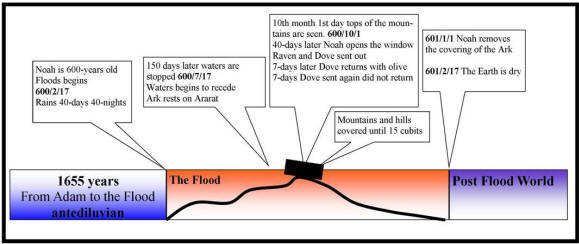
11. The Genesis Flood & The Ice Age
 The
frozen remains of a baby mammoth discovered in 2007 are stirring up
talk—especially because the mammoth is “remarkably preserved,”
National Geographic News reports.
The
frozen remains of a baby mammoth discovered in 2007 are stirring up
talk—especially because the mammoth is “remarkably preserved,”
National Geographic News reports.
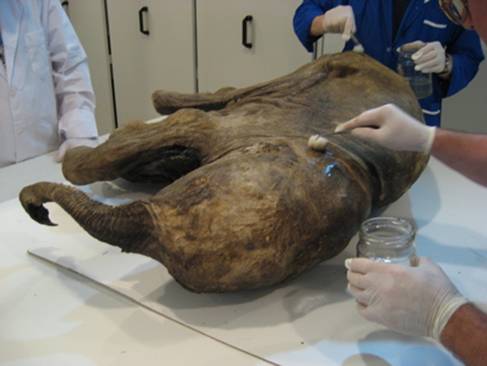
Found in the icy north of Siberia, the mammoth—named Lyuba—looks nearly lifelike. The photograph best shows how amazingly intact Lyuba is, with even eyelashes and clumps of brown wool remaining. Hers is the most complete woolly mammoth body to have ever been found.
By examining Lyuba’s body, paleontologists are gaining new insights into mammoth anatomy and health. From CT scans of her internal organs to mineral studies of her teeth, scientists now have better ideas about what she and other mammoths ate as well as how healthy she was when she died.
“No other specimen preserves this much of the original anatomy. That makes her a remarkable scientific resource,” said paleontologist Dan Fisher of the University of Michigan’s Museum of Palaeontology. “It looked like she’d just drifted off to sleep,” he continued. “Suddenly what I'd been struggling to visualize for so long was lying right there for me to touch.”
How Did She Die?
At first Lyuba’s well-preserved body suggests a mystery: scientists have determined that she was in good health and well fed when she died—so how did she end up frozen in time? Lyuba’s stomach contains important clues, as The Telegraph’s Richard Gray explains:
Sediment was found packed inside the baby mammoth’s trunk, blocking the nasal passages, and also in the mouth and windpipe. The experts believe that it may have suffocated to death after becoming trapped in the thick mud that eventually encased the body, where it had gradually pickled and was preserved.
And National Geographic News’s James Owen adds, “The oxygen-deprived environment of its final resting place, likely a watery marsh or bog, prevented decay and kept it intact save for only its tail and shaggy coat.”
But perhaps it isn’t so much of a mystery. Creationist mammoth expert Mike Oard, in his landmark 2004 work Frozen in Time, writes:
Strangely, scientists investigating three woolly mammoths and two woolly rhinos, including the Beresovka mammoth, found they all died by suffocation. For a live animal to die of suffocation, it had to be buried rapidly or drowned. [Emphasis in original]
 After
reviewing the facts and the post-Flood Ice Age model, Oard
eventually concludes:
After
reviewing the facts and the post-Flood Ice Age model, Oard
eventually concludes:
Cold, wind, flooding, and drought can account for many of the mammoth deaths, but there is still the question as to how most of them became interred in the permafrost. . . . The most-mentioned possibility is that the mammoths were trapped in bogs. Some undoubtedly were trapped in bogs. . . . Bogs would have been caused by the summer melting of the permafrost. When the top foot or two (about half a meter) of permafrost melts in the summer, the water would pool since the permafrost below remains frozen. The large animals inexperienced with bogs could possibly have fallen into one. However, a bog may form year after year, and the animal trapped in the bog may never end up in the permafrost below the bog. Furthermore, large animals likely are strong enough to pull themselves out of a shallow bog.
 But
for a baby mammoth, perhaps it was not strong enough to pull itself
out of even a shallow bog. An alternative possibility is that Lyuba
died in a large-scale local flood, as Oard explains:
But
for a baby mammoth, perhaps it was not strong enough to pull itself
out of even a shallow bog. An alternative possibility is that Lyuba
died in a large-scale local flood, as Oard explains:
During deglaciation, some of the animals would have been trapped by flooding rivers. Those that were trapped would have ended up in river terraces or flood plains that would be incorporated into the permafrost. Some animals lie buried in river deltas where they emptied into the Arctic Ocean.
Either way, Lyuba’s near-perfect preservation and sediment-filled lungs are yet another evidence of catastrophic, watery burial—not the gradual effect of uniform processes.
A Biblical View of Mammoths
According to the model of a post-Flood Ice Age (which Oard explains), the frozen mammoths we find today would have been preserved only a few thousand years ago.
By contrast, old-age scientists consider Lyuba to have died some 37,000 years ago. Yet even Alexei Tikhonov of the Russian Academy of Science notes, “When you look at [Lyuba], it’s hard to understand how she could have stayed in such good condition for nearly 40,000 years.”
We also see evidence that mammoths and elephants may have been part of the same created kind. Adding a small bit of evidence to that view, the Telegraph article notes that the scientists discovered dung in the Lyuba’s stomach in addition to her mother’s milk. This is the same behavior of baby elephants, which eat the dung of herd adults to fill their gut with the bacteria they need to digest grass later in life.
 Lyuba’s
discovery reminds us of the power of the biblical model of history.
Mammoths fit well into our understanding of created kinds. Noah
would have taken representatives of that kind on the Ark, after
which some of the descendants of those representatives would have
headed north. Those with such adaptations as “woolly” exteriors
would have survived in the cold of the post-Flood Ice Age, but for
reasons we will never know, they eventually died out. Yet the
perfect preservation of many mammoths remind us of the power of
catastrophic events to record major moments in Earth history.
Lyuba’s
discovery reminds us of the power of the biblical model of history.
Mammoths fit well into our understanding of created kinds. Noah
would have taken representatives of that kind on the Ark, after
which some of the descendants of those representatives would have
headed north. Those with such adaptations as “woolly” exteriors
would have survived in the cold of the post-Flood Ice Age, but for
reasons we will never know, they eventually died out. Yet the
perfect preservation of many mammoths remind us of the power of
catastrophic events to record major moments in Earth history.